- Home
- Clarity & Life Direction
- Midlife Decision Making Framework
Midlife Decision Making Framework
A calm way to choose your next step when life feels unclear.
Making decisions in midlife can feel different.
It is not always as simple as choosing between right and wrong.
Sometimes every option carries a cost.
Sometimes one path feels safer, but another feels more honest.
Sometimes you know something needs to change, but you do not trust yourself enough to choose.
And sometimes the decision feels heavy because it is not only practical.
It may touch your identity, your relationships, your responsibilities, your finances, your future, and the life you thought you were supposed to want.
This is why midlife decisions often need more than a quick pros and cons list.
They need space.
They need honesty.
They need a way to separate fear, pressure, values, needs, and next steps.
This midlife decision making framework is designed to help you slow the decision down, look at what is really involved, and choose one grounded next step.
On This Page
- Why midlife decisions can feel so hard
- A simple midlife decision making framework
- What to notice before you choose
- When every option has a cost
- Where to go next
Why Midlife Decisions Can Feel So Hard
Midlife decisions can feel hard because they often ask you to look at more than the decision itself.
You may not only be asking:
“What should I do?”
You may also be asking:
Who am I now?
What still matters?
What am I no longer willing to carry?
Who will be affected if I choose differently?
Can I trust myself to make this change?
That is why a decision that looks simple from the outside can feel complicated on the inside.
You may be weighing stability against freedom.
You may be weighing loyalty against honesty.
You may be weighing your needs against other people’s expectations.
You may be weighing what is familiar against what feels more aligned.
The aim is not to force a perfect answer.
The aim is to understand the decision clearly enough to take the next honest step.
A Simple Midlife Decision Making Framework
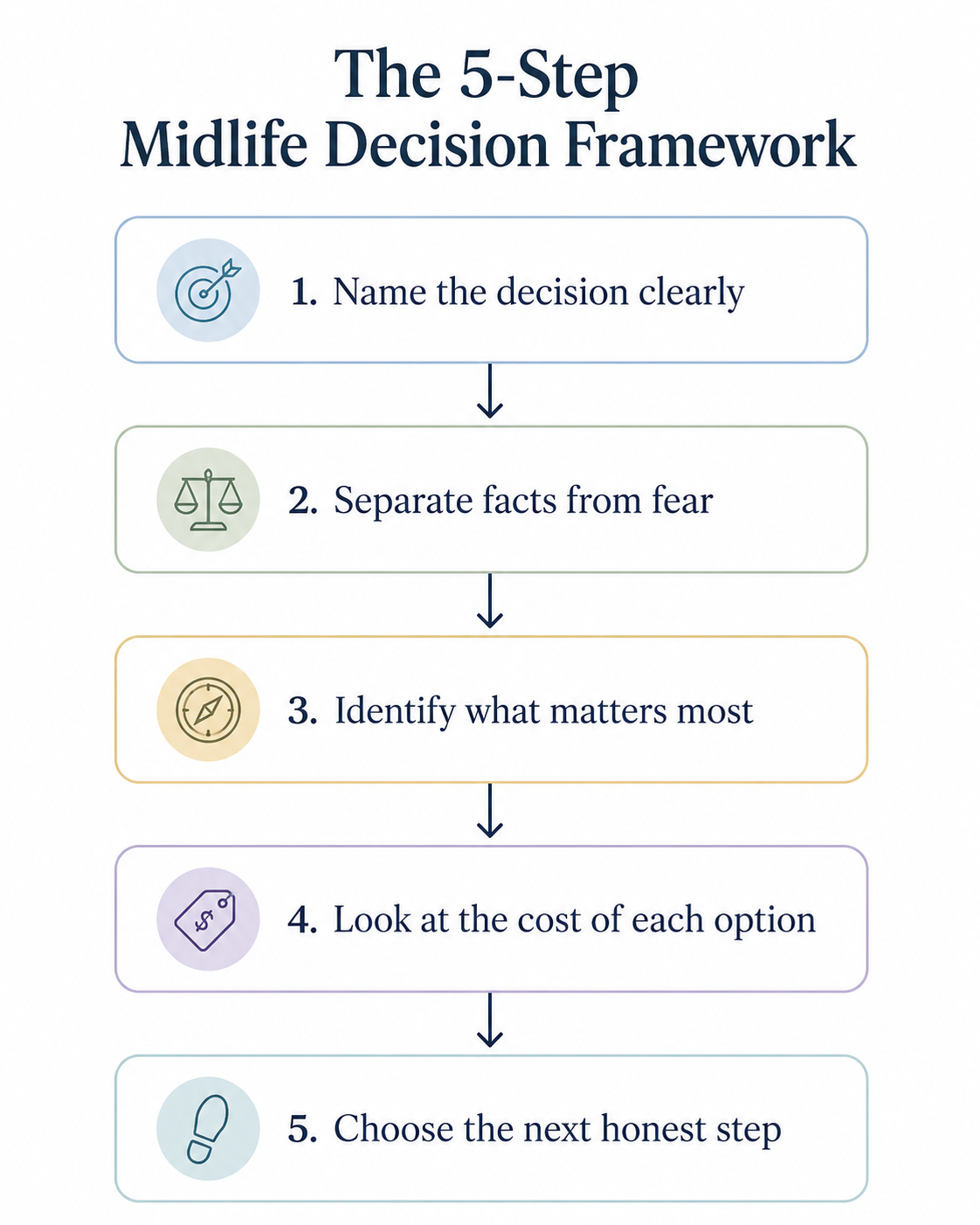
Use this framework when you feel unsure, stuck, or caught between options.
You can write your answers in a journal, notebook, or worksheet.
1. Name The Decision Clearly
Start by writing the decision in one plain sentence.
For example:
Should I stay in this role or look for something different?
Should I keep living the way I am, or make a lifestyle change?
Should I say yes, say no, or ask for more time?
Keep it simple.
If the decision is vague, your thinking will stay vague.
Ask yourself:
What am I actually deciding?
What decision am I avoiding?
What would make this decision clearer?
2. Separate Facts From Fear
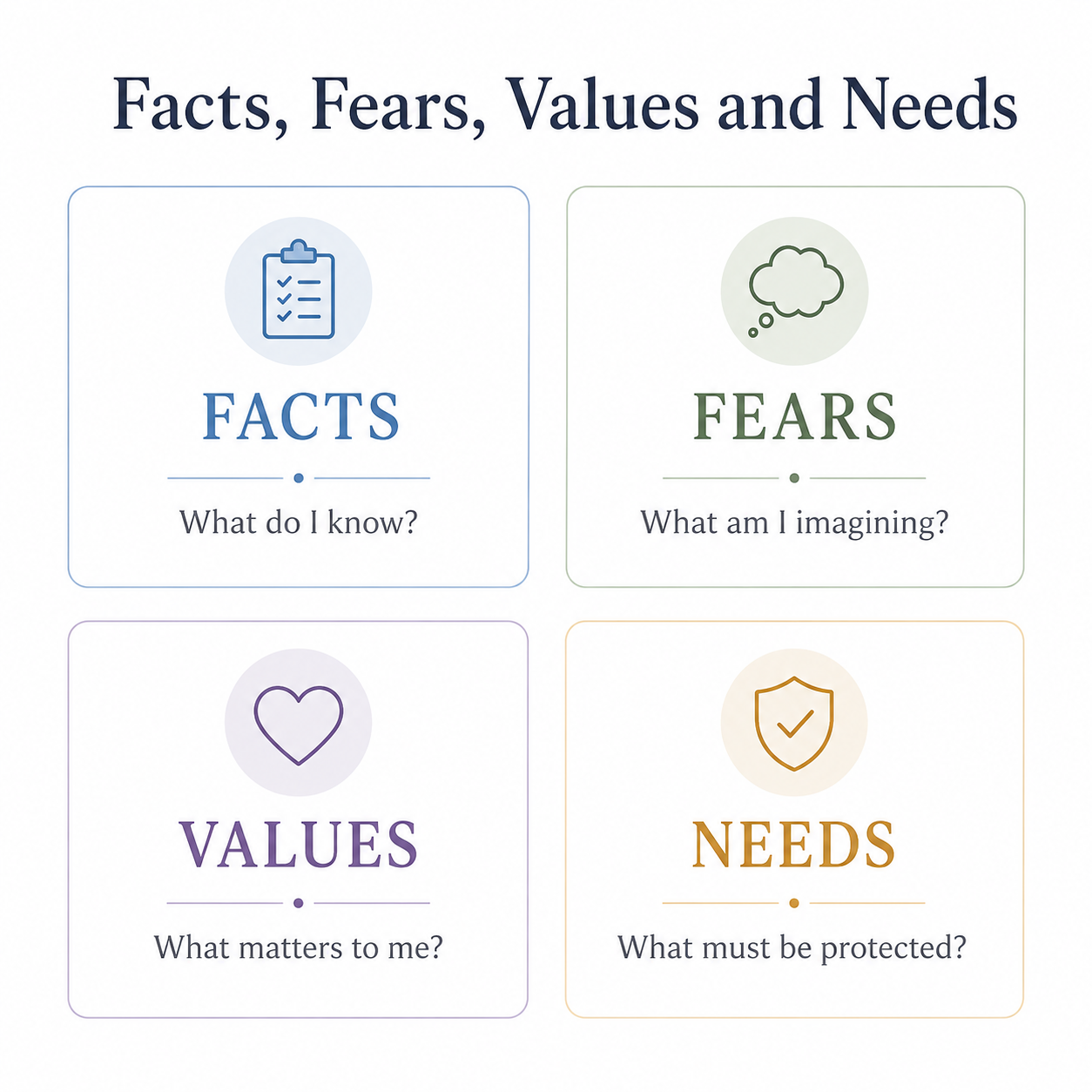
Next, write down what is factual and what is fear-based.
Facts are things you know.
Fears are things you are imagining, predicting, or worrying might happen.
Both matter, but they are not the same.
For example:
Fact: I am tired most of the time.
Fear: If I change something, I might disappoint everyone.
Fact: This role gives me income.
Fear: I may never find anything better.
Fact: I want more space.
Fear: Wanting more space makes me selfish.
This step matters because fear can sound like truth when you are already overwhelmed.
3. Identify What Matters Most
Now ask what this decision is really about.
Is it about peace?
Freedom?
Security?
Health?
Honesty?
Connection?
Purpose?
Self-respect?
Stability?
Sometimes the decision is not really about the surface choice.
It is about the value or need underneath it.
A choice may look sensible on paper but go against something that deeply matters to you now.
Or a choice may feel exciting but ignore a real need for safety, rest, or support.
Both values and needs matter.
Ask yourself:
What value is asking to be honoured here?
What need cannot be ignored?
What am I trying to protect?
What am I trying to move towards?
4. Look at the cost of each option
Every meaningful decision has a cost.
Staying has a cost.
Changing has a cost.
Waiting has a cost.
Choosing nothing also has a cost.
Instead of asking which option has no risk, ask:
Which cost am I willing and able to carry?
This question can create more honesty.
You may realise that the familiar path is costing you energy, aliveness, or self-trust.
You may realise that the new path would cost you certainty, comfort, or approval.
You may realise you are not ready for a big move, but you are ready for a small test.
5. Choose the next honest step
The aim is not always to make the whole decision today.
Sometimes the next step is enough.
A next honest step might be:
having a conversation
gathering information
setting a boundary
trying something for 30 days
writing down what you really want
asking for support
resting before deciding
choosing the smaller version of the change first
A good next step does not need to solve everything.
It needs to move you out of circling and into clearer contact with yourself.
What to Notice Before You Choose
Before you make the decision, pause and notice what is happening in you.
Do you feel pressured?
Do you feel afraid?
Do you feel relieved?
Do you feel clear?
Do you feel contracted?
Do you feel more honest?
Your body and emotions do not always give you the final answer, but they can give you useful information.
They may show you where you are forcing yourself.
They may show you where you are avoiding something.
They may show you where a small truth is trying to come through.
You are not looking for a perfect feeling.
You are looking for what deserves your attention.
When Every Option Has a Cost
Some midlife decisions feel hard because there is no option that feels completely easy.
You may feel that whichever direction you choose, something will be lost.
That does not mean you are choosing badly.
It may mean you are facing a real transition.
In that situation, the question becomes less about finding the perfect option and more about choosing the direction that is most honest, sustainable, and aligned with who you are becoming.
If every option feels like a loss, it may help to start smaller.
Ask:
What is the least harmful next step?
What would give me more information?
What would reduce pressure without shutting down the truth?
What can I test before I commit?
What decision does not need to be made today?
Where to Go Next
Use the pages below to go deeper into the part of the decision that feels most relevant.
I want to make a low-regret decision
Use this when you want to choose in a way that your future self is less likely to regret.
→ What is a low-regret decision framework for midlife changes?
Link: future T4 page
Every option feels like a loss
Use this when you feel trapped between choices and none of them feel easy.
→ How do I choose a next step when every option feels like a loss?
Link: future T4 page
I am trying to weigh values and needs
Use this when you are torn between what matters emotionally and what is needed practically.
→ Values vs needs: how do I weigh them in midlife decisions?
Link: future T4 page
I am wondering if a decision matrix will help
Use this when you want structure, but you are not sure whether logic alone will work for an emotional decision.
→ Does a decision matrix work for emotional midlife decisions, or does it backfire?
Link: future T4 page
I do not trust myself to choose
Use this when a big life change has knocked your confidence and you feel unsure about your own judgement.
→ How do I make a decision when my confidence is low after a big life change?
Link: future T4 page
Start With One Decision
You do not need to decide your whole future today.
Choose one decision that has been taking up space in your mind.
Write it down.
Separate facts from fear.
Notice what matters.
Look honestly at the cost of each option.
Then choose one small next step.
Clarity often comes after movement, not before it.
When You Want Support
If you are stuck in a decision and keep circling the same thoughts, you do not have to work through it alone.
A Clarity Call gives you space to look at the decision, what is making it feel difficult, and what your next honest step could be.
→ Book a Clarity Call
Privacy Policy