- Home
- Feeling Stuck
- Autopilot Living in Midlife
Autopilot Living in Midlife:
How to Notice and Interrupt It
Autopilot living in midlife can feel like functioning well on the outside while moving through your days without much presence, connection, or conscious choice.
It often grows out of responsibility, coping, and long habit rather than failure, and this page will help you recognise the pattern and interrupt it with one small moment of awareness.
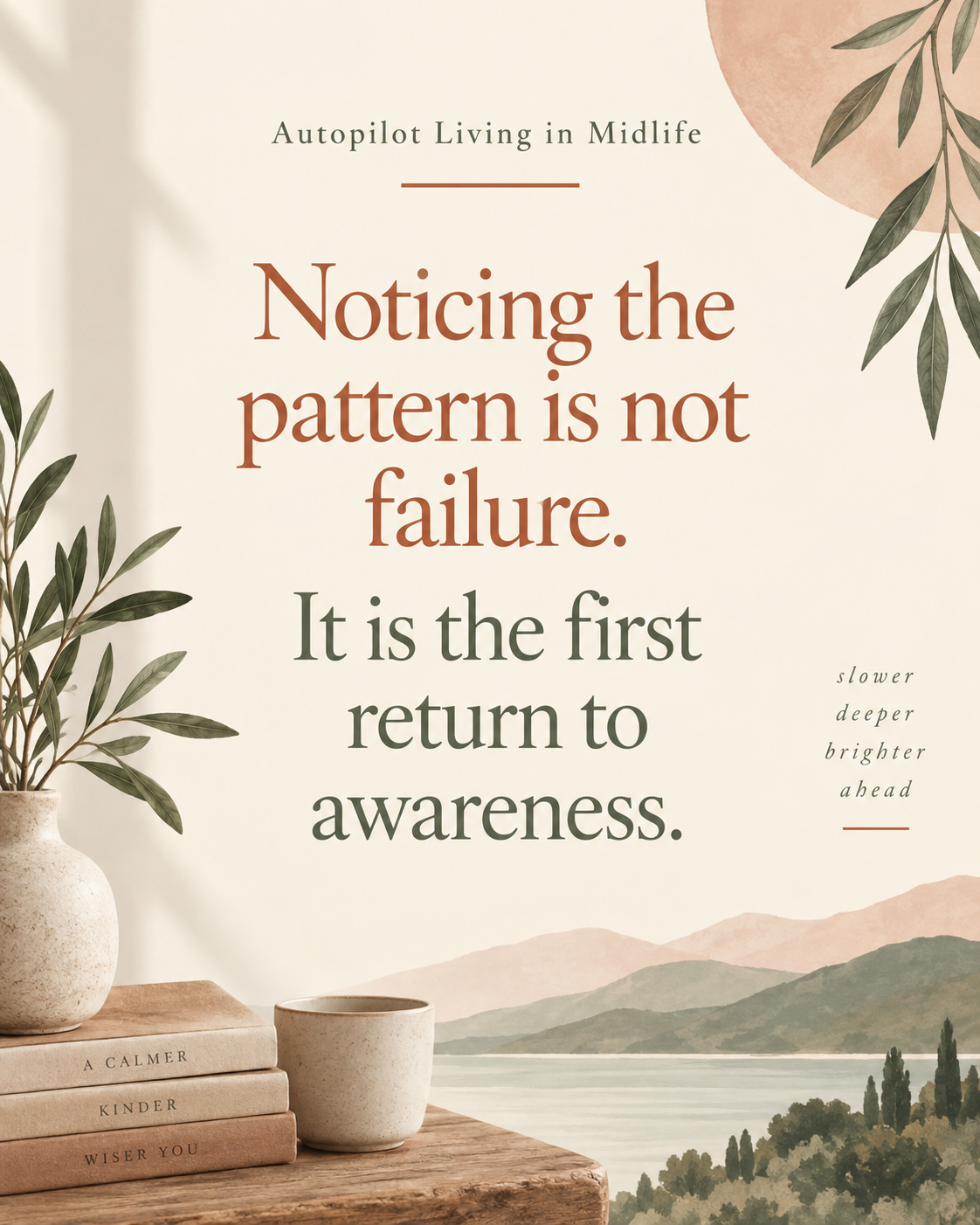 Noticing the pattern is not failure. It is the first return to awareness.
What Awareness Can Reopen
Noticing autopilot living in midlife is not a criticism.
It is a return point.
You may have been moving through your days for a long time doing what needed to be done.
Working.
Caring.
Managing.
Remembering.
Responding.
Keeping things moving.
From the outside, that can look capable.
And it may be capable.
But capability is not the same as presence.
You can be functioning and still feel strangely absent from your own life.
You can be reliable and still feel disconnected from what you want.
You can keep meeting expectations and still wonder when you stopped consciously choosing.
Awareness does not fix everything immediately.
But it can reopen a small space between the pattern and your next response.
That space matters.
It gives you a moment to notice:
“Is this what I want?”
“Am I here, or am I just moving?”
“What am I feeling?”
“What would I choose if I paused before continuing?”
That is where change can begin.
Not with a full life overhaul.
With one moment where you come back into contact with yourself.
What Autopilot Living in Midlife Actually Is
Autopilot living in midlife is the experience of moving through life automatically rather than consciously.
You may still be doing all the right things.
You may still be meeting responsibilities.
You may still be showing up for work, family, home, appointments, messages, and everything else that needs your attention.
But inside, you may not feel fully there.
Your days may start to blur.
Your choices may feel more like habits than decisions.
Your responses may come out before you have checked whether they are true.
Your body may be present, but your attention may be somewhere else.
This is not the same as laziness.
It is not proof that you have failed.
It is often what happens when life has trained you to keep going, even when you are tired, overloaded, disconnected, or unsure what you want.
Autopilot can help you get through demanding seasons.
But if it becomes the main way you live, it can slowly disconnect you from your own preferences, feelings, energy, and sense of direction.
That is why autopilot living in midlife matters.
It can look functional from the outside while quietly taking you further away from yourself.
How Autopilot Quietly Develops in Midlife
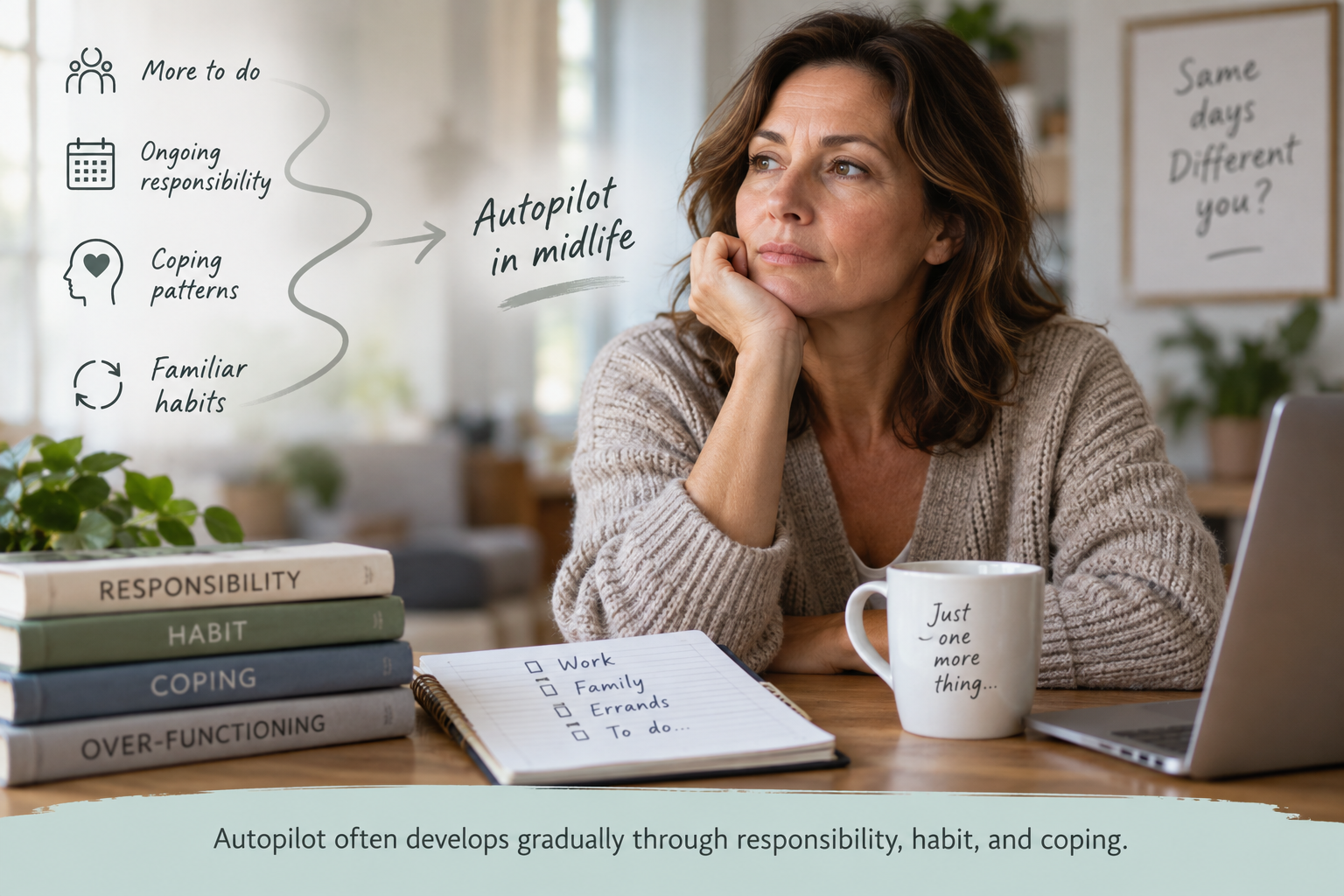 Autopilot often develops gradually through responsibility, habit, and coping.
Autopilot rarely appears overnight.
It usually develops slowly.
One responsibility at a time.
One coping season at a time.
One repeated pattern at a time.
You may start by doing what needs to be done because there is no real choice in that moment.
You keep going because people are depending on you.
You push through because the work has to be finished.
You stay steady because someone else needs you to be steady.
You become practical because feelings do not seem useful when there is too much to manage.
At first, that may be necessary.
It may even be wise.
Autopilot can help you get through difficult, demanding, or emotionally crowded seasons.
But over time, the same pattern can become your default.
You may stop checking what you feel.
You may stop asking what you want.
You may stop noticing what drains you.
You may move from one task to the next without much sense of choice.
This is how autopilot living in midlife can develop without you realising it.
Not because you were careless.
Not because you lacked awareness.
But because life kept asking you to function, and functioning became the habit.
Responsibility Can Train Automatic Living
Responsibility can teach you to keep moving before you check in with yourself.
There may have been seasons where that was necessary.
You had work to do.
People to support.
Bills to pay.
Children, parents, partners, teams, clients, or households needing your attention.
You may have become very good at noticing what everyone else needed.
What had to be done next.
What could not be dropped.
What would fall over if you stopped.
Over time, that kind of responsibility can train automatic living.
You become efficient.
You become dependable.
You become the person who copes.
But somewhere along the way, you may stop asking:
“What do I need?”
“What do I feel?”
“What do I want now?”
“What is this costing me?”
That is not weakness.
It is often the cost of being capable for too long without enough space to come back to yourself.
Coping, Habit, & Over-Functioning Can Keep It Going
Autopilot can begin as coping.
You find a way to get through a hard season.
You keep your head down.
You focus on what needs doing.
You avoid feeling too much because feeling too much would make it harder to keep going.
That can be protective for a while.
But coping patterns can become familiar long after the original pressure has passed.
Habit keeps the pattern running.
You wake up and move straight into the same rhythm.
You answer the same way.
You carry the same load.
You push through the same tiredness.
You override the same signals.
Over-functioning can keep it going too.
You may keep doing more than your share because it feels safer than letting things be messy, disappointing someone, or admitting you are stretched.
You may stay busy because stopping would make you feel what has been waiting underneath.
This is why autopilot living in midlife can feel so hard to interrupt.
It is not only a habit.
It may also be a protection.
 You do not need to fix everything before you begin again.
A way of staying functional.
A way of avoiding disruption.
A way of keeping life moving when part of you has not had room to breathe.
The shift begins when you can see the pattern without attacking yourself for having it.
Signs You Are Going Through the Motions
Autopilot living in midlife can be easy to miss because the signs often look ordinary.
You may still be doing life.
You may still be productive.
You may still be getting things done.
But the way you are moving through your life may feel more automatic than alive.
You might notice that whole days or weeks blur together.
You might finish a task and barely remember doing it.
You might move from work to errands to messages to chores without ever feeling fully present.
You might be in conversations, but only half there.
You might keep saying, “I’m fine,” because you do not have the energy to explain what feels off.
You might feel disconnected from small pleasures that used to reach you.
You might avoid quiet time because stillness would make you aware of how absent you feel.
You might keep doing what is expected without asking whether it still fits.
You might feel as though life is happening around you, while you are simply keeping up with it.
These signs do not mean you are broken.
They may simply mean your awareness has been crowded out by habit, responsibility, stress, or repetition.
The point is not to judge yourself for going through the motions.
The point is to notice where your life has become automatic, so you can begin to come back into it.
Daily-Life Signs Worth Noticing
The signs of autopilot are often small enough to explain away.
You may notice them in ordinary moments.
You read the same paragraph three times and still do not take it in.
You drive somewhere familiar and barely remember the journey.
You open your phone without knowing what you were looking for.
You say yes before you have checked whether you mean it.
You eat, scroll, work, tidy, reply, or organise without feeling fully present.
You move through the same routine and realise nothing in the day felt chosen.
You may also notice it in your body.

A shallow breath.
A tight jaw.
A tired heaviness.
A restless need to keep moving.
A sense of being switched on, but not truly connected.
These signs are not there to make you criticise yourself.
They are there to help you notice where awareness has gone missing.
Once you can see one daily pattern clearly, you have somewhere small to begin.
One Small Interruption Is Enough to Start
You do not need a full reset to interrupt autopilot living in midlife.
You only need one small moment where you stop moving automatically and come back into contact with yourself.
That might be a pause between tasks.
A breath before answering a message.
A moment before saying yes.
A hand on your heart before you rush into the next thing.
A short question before you continue the same pattern.
The interruption does not need to be impressive.
It needs to be conscious.
You are not trying to change your whole life in one moment.
You are creating a gap.
A small space between what you usually do and what you might choose next.
That space gives awareness somewhere to return.
It lets you notice what is happening before habit takes over.
It lets you ask whether the next action is still true, useful, kind, necessary, or automatic.
This is where change can begin without becoming another project.
One small interruption is enough because it proves something important:
You are not only the pattern.
You are also the person who can notice the pattern.
Choose One Recurring Moment to Interrupt
Choose one moment that already happens most days.
Do not choose the hardest moment.
Choose a repeatable one.
It might be the moment before you open your laptop.
The moment before you answer a message.
The moment before you get out of the car.
The moment before you walk into the house.
The moment before you say yes.
The moment before you move from one task to the next.
Then use that moment as a small awareness point.
Pause.
Notice your body.
Notice your breath.
Notice your first automatic response.
Ask yourself:
“What is happening in me right now?”
That is enough.
You do not need to solve anything immediately.
You are simply interrupting the automatic pattern long enough to come back into the room, the moment, and yourself.
Over time, one recurring interrupt can create more awareness than waiting for a perfect quiet hour that never arrives.
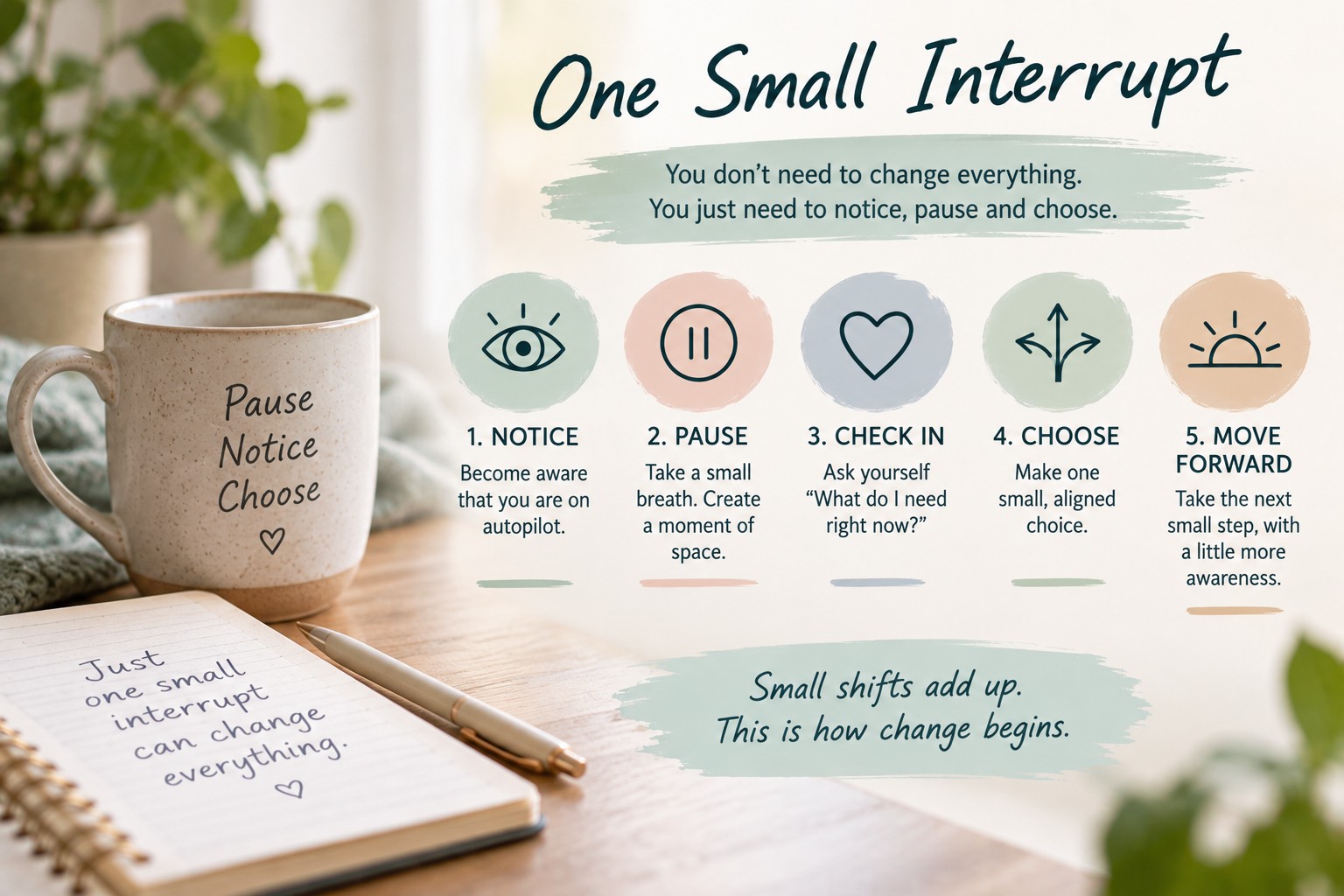 A small interrupt works better than a dramatic reset.
Ask a Noticing Question, Not a Fixing Question
When you interrupt autopilot, try not to turn the pause into another pressure point.
You are not stopping so you can immediately fix your life.
You are stopping so you can notice what is true.
A fixing question sounds like:
“What do I need to do about this?”
“How do I solve this?”
“What is the answer?”
“What should I change?”
Those questions may come later.
But at the beginning, they can make your nervous system tighten and send you straight back into doing mode.
A noticing question is gentler.
You might ask:
“What am I feeling right now?”
“What am I avoiding?”
“What do I need to admit, just to myself?”
“Is this response automatic or honest?”
“What would create a little more space here?”
These questions do not demand an immediate life decision.
They simply help you return to awareness.
That is the first interruption.
Not fixing.
Not forcing.
Just noticing.
What Can Change After One Honest Pause
One honest pause may not change the outside of your life immediately.
But it can change the way you are inside the moment.
You may notice that you were about to say yes when you meant no.
You may realise you are tired before you push through again.
You may feel how much you have been carrying.
You may notice that something feels heavier than you have admitted.
You may hear a preference you have been overriding.
You may catch yourself before you disappear into the next task.
These are small shifts.
But they matter.
Because autopilot living in midlife often continues when there is no space between awareness and action.
 The first shift is usually subtle: a little more contact with your own life.
A pause creates that space.
It gives you a chance to respond instead of only repeat.
You may still choose the same action.
You may still do the task.
You may still meet the responsibility.
But now you are doing it with a little more consciousness.
That is the beginning of coming back to yourself.
Not as a dramatic reinvention.
As a quieter return to presence, choice, and honesty.
When Autopilot Points to Deeper Support
Sometimes autopilot is a normal response to responsibility, habit, or a demanding season.
But sometimes it points to something heavier.
If you feel persistently numb, detached, hopeless, emotionally shut down, or unable to cope, it may be a sign that you need more support than one small awareness practice can give.
That does not mean there is something wrong with you.
It means the pattern may need care, not just noticing.
Autopilot living in midlife can overlap with burnout, depression, grief, anxiety, or emotional exhaustion.
The difference is often the depth, duration, and impact.
If you are only noticing that life has become too automatic, a small interrupt may be enough to begin.
If you feel unable to function, unable to feel, or unsafe with yourself, please reach out to a qualified health professional or a crisis support service.
You do not have to work it all out alone.
Support is not a sign that you have failed.
It is one way of coming back to yourself with more care.
If you feel unsafe with yourself, or you are having thoughts of harming yourself, please contact a qualified health professional or a crisis support service such as Lifeline Australia.
FAQs
Is autopilot living in midlife the same as depression?
Not always. Autopilot living in midlife can be a pattern of habit, responsibility, coping, or disconnection. Depression can involve deeper and more persistent changes in mood, energy, sleep, appetite, motivation, hopelessness, or ability to function. If the feeling is persistent, heavy, or affecting your safety or daily life, it is worth seeking professional support.
Why do I feel like I am just going through the motions?
You may feel like you are going through the motions because life has become more about managing than consciously choosing. This can happen after long periods of responsibility, stress, caregiving, work pressure, emotional load, or simply repeating the same routines for a long time.
How do I stop living on autopilot?
Start with one small interruption. Choose one recurring moment in your day, pause, and ask a noticing question such as, “What is happening in me right now?” You do not need to fix everything immediately. The first step is to notice the pattern before you repeat it.
Ready to Interrupt Autopilot and Come Back to Yourself?
If autopilot living in midlife feels familiar, you do not need to overhaul your life today.
Start with one small moment of awareness.
Notice where you are moving automatically, what you are overriding, and what one honest pause might show you.
The Wheel of Life Assessment can help you look across the main areas of your life and notice where you may be functioning, coping, or going through the motions.
If you would rather talk it through, a Clarity Call gives you space to explore what feels automatic, what may need attention, and what one conscious next step could look like.
→ Complete the Wheel of Life Assessment
Privacy Policy