- Home
- Feeling Stuck
- Feeling Stuck But Life Looks Fine
- Quiet Stuckness
What Is Quiet Stuckness in Midlife?
Quiet stuckness in midlife is not always obvious at first. It usually signals an inner mismatch rather than a crisis. This page will help you recognise the signs and understand what that mismatch may be trying to show you.
 Quiet stuckness often looks ordinary from the outside.
Recognising Quiet Stuckness in Midlife
Quiet stuckness in midlife can feel confusing because there may be no obvious crisis to explain it.
It can look like normal life.
You may still be working, caring for others, keeping appointments, answering messages, making decisions, and doing what needs to be done.
From the outside, nothing may look especially wrong.
But inside, something feels muted.
You may feel flat, restless, disconnected, quietly resentful, or strangely distant from the life you are living.
You may notice that you are going through the motions rather than fully choosing them.
You may still be grateful for parts of your life, but find yourself wondering why gratitude does not make the feeling disappear.
That is one of the confusing parts of quiet stuckness.
It does not always arrive as a breakdown.
It often arrives as a slow inner signal.
A sense that something has become too small.
A sense that something no longer fits.
A sense that the life you are living is still functioning, but not fully true.
This does not mean you are ungrateful, selfish, or dramatic.
It may simply mean that something inside you is asking to be noticed.
Why It Can Show Up Even When Life Looks Fine
Quiet stuckness in midlife may be trying to show you what no longer fits.
Your life may still be working.
You may still be meeting responsibilities, caring for people, paying bills, keeping routines going, and doing what others expect from you.
You may even have parts of your life that you genuinely value.
That is why the feeling can be easy to dismiss.
You may tell yourself:
“I should be grateful.”
“Other people have bigger problems.”
“Nothing is really wrong.”
“Maybe I am just tired.”
Sometimes tiredness is part of it.
But quiet stuckness is often more than tiredness.
It can appear when the life you built around one version of yourself no longer fully fits the woman you are now.
In midlife, roles can shift.
Energy can change.
Children may need you differently.
Work may feel less meaningful.
Relationships may ask for a different level of honesty.
Old coping patterns may stop working.
The outside structure of your life may still look steady, but inside there may be a growing gap between what you are doing and what feels true.
That gap is worth noticing.
Not because it means your life is wrong.
But because it may be showing you where something needs to be seen more honestly.
What Quiet Stuckness May Be Trying to Show You
Quiet stuckness in midlife is not the same as failure.
It may be asking you to notice what no longer fits.
Sometimes it points to an old role.
You may still be acting as the responsible one, the capable one, the peacekeeper, the carer, the organiser, or the person who keeps things moving.
Those roles may have helped you survive, belong, succeed, or feel needed.
But a role that once protected you can later begin to limit you.
Sometimes quiet stuckness points to a routine that has gone stale.
Your days may work on paper, but leave very little room for energy, creativity, rest, honesty, or choice.
Sometimes it points to an expectation you have been carrying for too long.
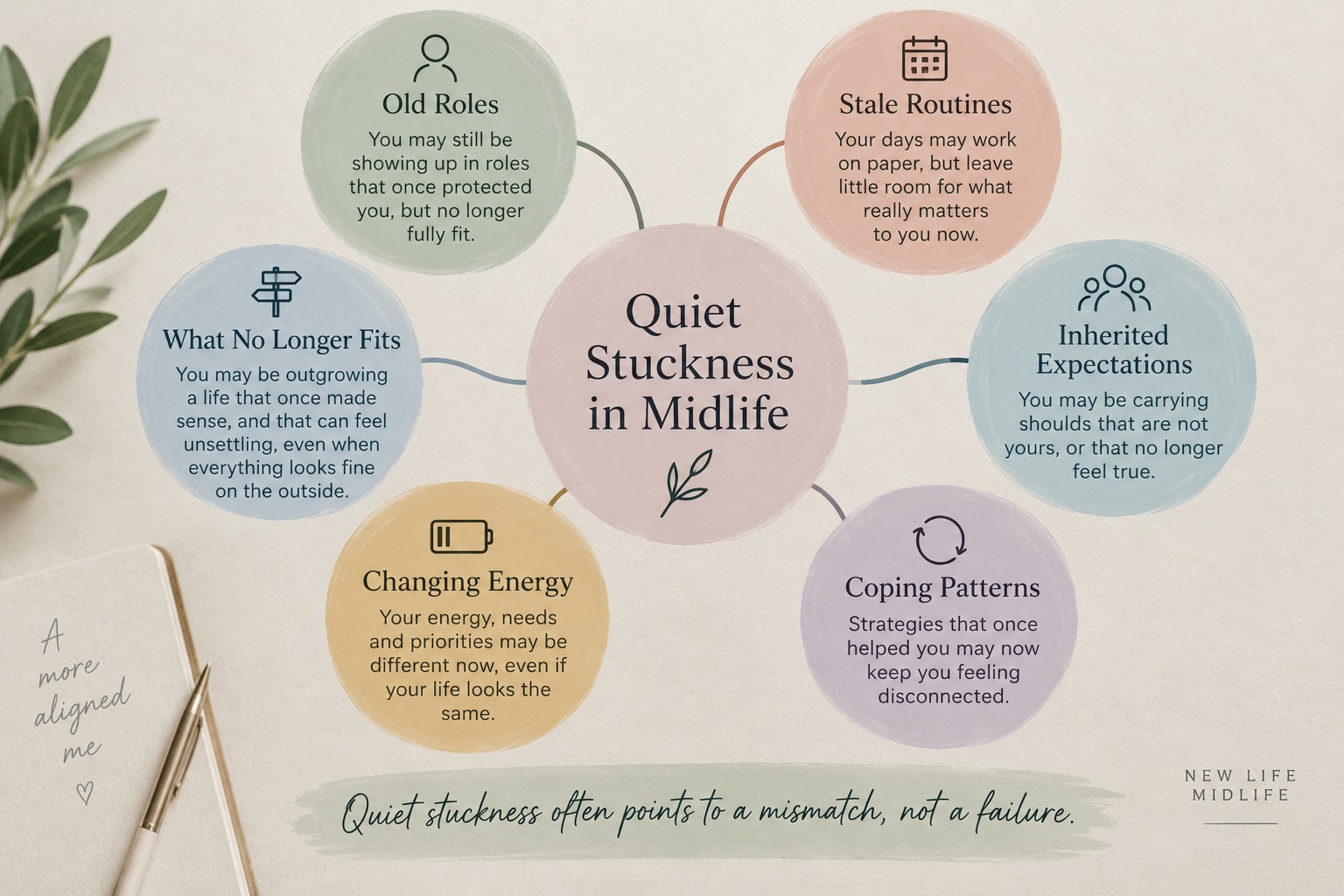
The expectation to be grateful.
To be sensible.
To keep coping.
To not want too much.
To not make things difficult.
Sometimes it points to a coping pattern that used to help, but now keeps you disconnected.
Staying busy.
Keeping the peace.
Overthinking.
Avoiding the question.
Waiting until you feel certain.
Quiet stuckness may be trying to show you that the old way still functions, but it no longer feels fully true.
That is useful information.
You do not need to turn it into a major decision yet.
You can start by asking:
“What no longer fits the woman I am now?”
What Quiet Stuckness Is Not
Quiet stuckness is not the same as failure.
It is not proof that you are ungrateful.
It is not a sign that your whole life is wrong.
It is not a demand to make a dramatic change before you are ready.
It is also not something to ignore if it becomes intense, persistent, or starts affecting your ability to function day to day.
If you feel persistently hopeless, unable to cope, or at risk of harming yourself, please contact a qualified health professional or a crisis support service such as Lifeline Australia.
Quiet stuckness usually sits in the space between “everything is fine” and “something is seriously wrong.”
It may feel subtle.
But subtle does not mean meaningless.
It may be an early signal that something inside you wants more honesty, attention, rest, space, or change.
The important thing is not to turn it into panic.
And not to dismiss it completely.
You can take it seriously without making it dramatic.
You can listen to it without deciding your whole future today.
A Gentle Next Step Before You Change Anything
If quiet stuckness feels familiar, you do not need to rush into a major decision.
Start by noticing one thing that no longer feels fully true.
Not everything.
Just one thing.
You might ask:
“What am I tired of pretending is fine?”
“What role feels too small now?”
“What part of my routine drains more energy than it gives?”
“What do I keep postponing, avoiding, or dismissing?”
You are not looking for a perfect answer.
You are looking for a clue.
Once you have one clue, choose one small next step that helps you explore it gently.
That might be writing it down, taking the Wheel of Life Assessment, having one honest conversation, booking quiet time for yourself, or trying one small change in your routine.
The aim is not to solve your whole life today.
The aim is to stop dismissing the signal.
Quiet stuckness often begins to shift when you stop asking, “What is wrong with me?” and start asking, “What is this trying to show me?”
Ready to Listen to What Quiet Stuckness Is Showing You?
If quiet stuckness in midlife feels familiar, you do not need to force yourself into a major decision.
Start by noticing what no longer feels fully true.
The Wheel of Life Assessment can help you look across the main areas of your life and see where something may be asking for attention.
If you would rather talk it through, a Clarity Call gives you space to explore what feels unclear, what may no longer fit, and what one honest next step could be.
→ Complete the Wheel of Life Assessment
Privacy Policy