What’s a Decision-Light Next Step When I Feel Stuck but Life Looks Fine?
A decision-light next step is one small, reversible action that creates movement when you feel stuck but your life looks fine from the outside.
If you feel stuck but your life looks fine from the outside, the best first move is usually not a big decision. It is one small, reversible action that creates movement and gives you information. You are not trying to solve your whole life at once; this page will show you how to choose a calmer next step.
You do not need a life overhaul to begin moving.
A decision-light step is small, reversible, and designed to help you learn what feels true before you make a bigger decision.

Decision-Light Movement Creates Clarity
When you feel stuck, it is easy to believe you need a big answer before you can move.
You may think you need to know whether to change your work, your relationship, your home, your routine, your priorities, or the whole direction of your life.
That pressure can make you freeze.
The bigger the question becomes, the harder it is to take any step at all.
But when life looks fine from the outside, the first step is usually not to make a dramatic decision.
The first step is to create a small amount of movement.
A decision-light step is not about proving that you know exactly what you want.
It is about giving yourself enough movement to learn something.
You are not trying to solve your whole life.
You are not trying to explain everything.
You are not trying to make a decision you cannot undo.
You are simply choosing one small action that helps you notice what feels true.
Sometimes clarity does not arrive before action.
Sometimes clarity comes because you take one safe, honest step and pay attention to what it shows you.
What Makes a Next Step Decision-Light
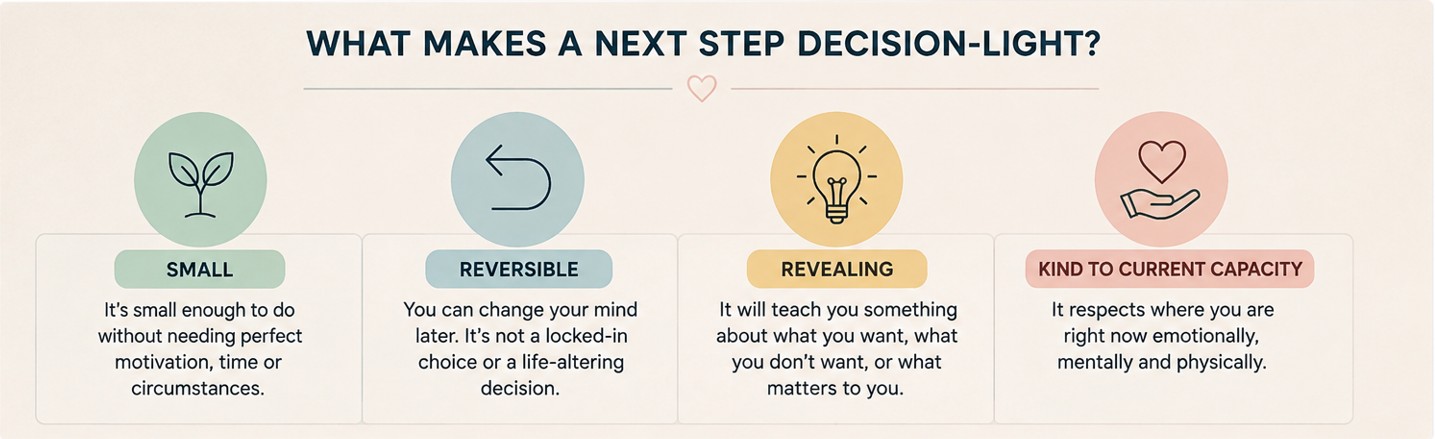 A useful next step should lower pressure, not add more.
A decision-light next step should lower pressure rather than add more.
It does not ask you to choose the rest of your life.
It does not require you to explain yourself to everyone.
It does not force you to commit before you are clear.
It simply helps you test what feels true.
A useful decision-light step has four qualities.
It is small.
You can do it without needing to rearrange your whole life. It fits inside your current capacity.
It is reversible.
If it does not feel right, you can stop, change direction, or learn from it without major consequences.
It is revealing.
It gives you information. It helps you notice what gives you energy, what drains you, what feels freeing, or what feels heavier.
It is kind to your current capacity.
It does not demand a version of you who has endless time, energy, confidence, or clarity. It starts with the woman you are today.
That is what makes it different from a big life decision.
A big decision asks, “What am I going to do with my life?”
A decision-light step asks, “What can I try this week that may show me something useful?”
How to Choose One Small Reversible Move.
 One small move can give you more information than another week of overthinking.
Start by choosing one area that feels active right now.
Not the whole problem.
Not your whole life.
Just one area.
It might be your energy, work, relationships, routine, confidence, home, health, creativity, or sense of identity.
Then ask yourself:
What is one small move I could make here that does not require a final decision?
For example, instead of deciding whether to leave your job, your small move might be updating your CV, looking at one role, or noticing what drains you most during the week.
Instead of deciding whether your relationship needs to change, your small move might be naming one conversation you have been avoiding.
Instead of deciding what you want your next chapter to be, your small move might be taking one hour alone without filling it with tasks.
A decision-light next step should lower pressure rather than add more.
A decision-light move should feel possible within your real life.
It should not rely on a sudden burst of confidence.
It should not need everyone else to understand.
It should not create unnecessary pressure.
Use this simple filter:
Can I do this within the next seven days?
Can I reverse it, stop it, or adjust it if it does not feel right?
Will it teach me something about what I want, need, avoid, or value?
Does it respect my current energy and capacity?
One exception: if your situation involves harm, abuse, serious mental health concerns, financial danger, or anything affecting your immediate safety, do not treat it as a decision-light experiment.
In that situation, the wiser next step is to seek appropriate professional, legal, financial, or crisis support.
*If your situation involves harm, abuse, serious mental health concerns, financial danger, or anything affecting your immediate safety, do not treat this as a decision-light experiment.*
*If you feel persistently hopeless, unable to cope, or at risk of harming yourself, please contact a qualified health professional or a crisis support service such as Lifeline Australia.*
If the answer is yes, you have found a decision-light next step.
Write it down in one sentence:
This week, I will...
Keep it small enough that you can actually do it.
Examples of Decision-Light Next Steps When Life Looks Fine
A decision-light next step will look different depending on where your stuckness is showing up.
The point is not to choose the perfect action.
The point is to choose something small enough to do, but clear enough to teach you something.
If work feels flat, your next step might be to spend twenty minutes looking at roles that interest you, not because you are leaving, but because you want to notice what attracts or repels you.
If your routine feels repetitive, your next step might be to change one part of one day and see whether it gives you more energy.
If you feel disconnected from yourself, your next step might be to spend one quiet hour without filling it with tasks, scrolling, or other people’s needs.
If you feel resentful, your next step might be to notice where you are saying yes when you already know you mean no.
If you feel unsure what you want, your next step might be to write down three things you miss, three things you envy, or three things you keep postponing.
If your relationship feels fine but you feel off inside it, your next step might be to name one thing you have stopped saying honestly.
None of these steps force a final answer.
They simply create evidence.
After one small step, you may know:
“This gave me energy.”
“This felt heavier than I expected.”
“I am not ready for that.”
“I want more of this.”
“That is not the real issue.”
That information matters.
It gives you something clearer to work with than circling the same thoughts in your mind.
What to Notice After You Take the Step.
After you take one decision-light step, do not rush to judge whether it worked.
The purpose of the step is not to get everything right.
The purpose is to notice what it shows you.
Ask yourself:
Did this give me more energy, or less?
Did I feel relief, resistance, interest, sadness, guilt, or possibility?
Did anything become clearer after I took the step?
Did this point me toward something I want more of, or something I am ready to stop carrying?
Sometimes the step will show you what you want.
Sometimes it will show you what you do not want.
Sometimes it will show you that you need rest before you need change.
Sometimes it will show you that the real issue is not where you first thought it was.
All of that is useful.
A decision-light step is not a test you pass or fail.
It is a way of gathering information from your real life instead of staying trapped in your thoughts.
Once you have taken one step, you can choose the next one in the same way.
Small.
Reversible.
Revealing.
Kind to your current capacity.
That is how movement begins without forcing yourself into a decision you are not ready to make.
Ready to Choose One Small Next Step?
If life looks fine but you still feel stuck, you do not need to force a major decision today.
Start smaller.
Notice one area that feels heavy, choose one reversible step, and let that step show you something useful.
If you want a clearer starting point, the Wheel of Life Assessment can help you see which area of your life may need attention first.
If you would rather talk it through, a Clarity Call gives you space to look at what feels unclear, what may be keeping you stuck, and what your next honest step could be.
→ Complete the Wheel of Life Assessment
Privacy Policy