Stability vs Stagnation in Midlife
Stability vs stagnation in midlife is not always easy to recognise because both can look calm from the outside. Healthy stability still feels alive, chosen, and able to adjust when you do. Stagnation feels more like a life that keeps functioning but no longer fits. The difference is whether your life still gives you room to grow.
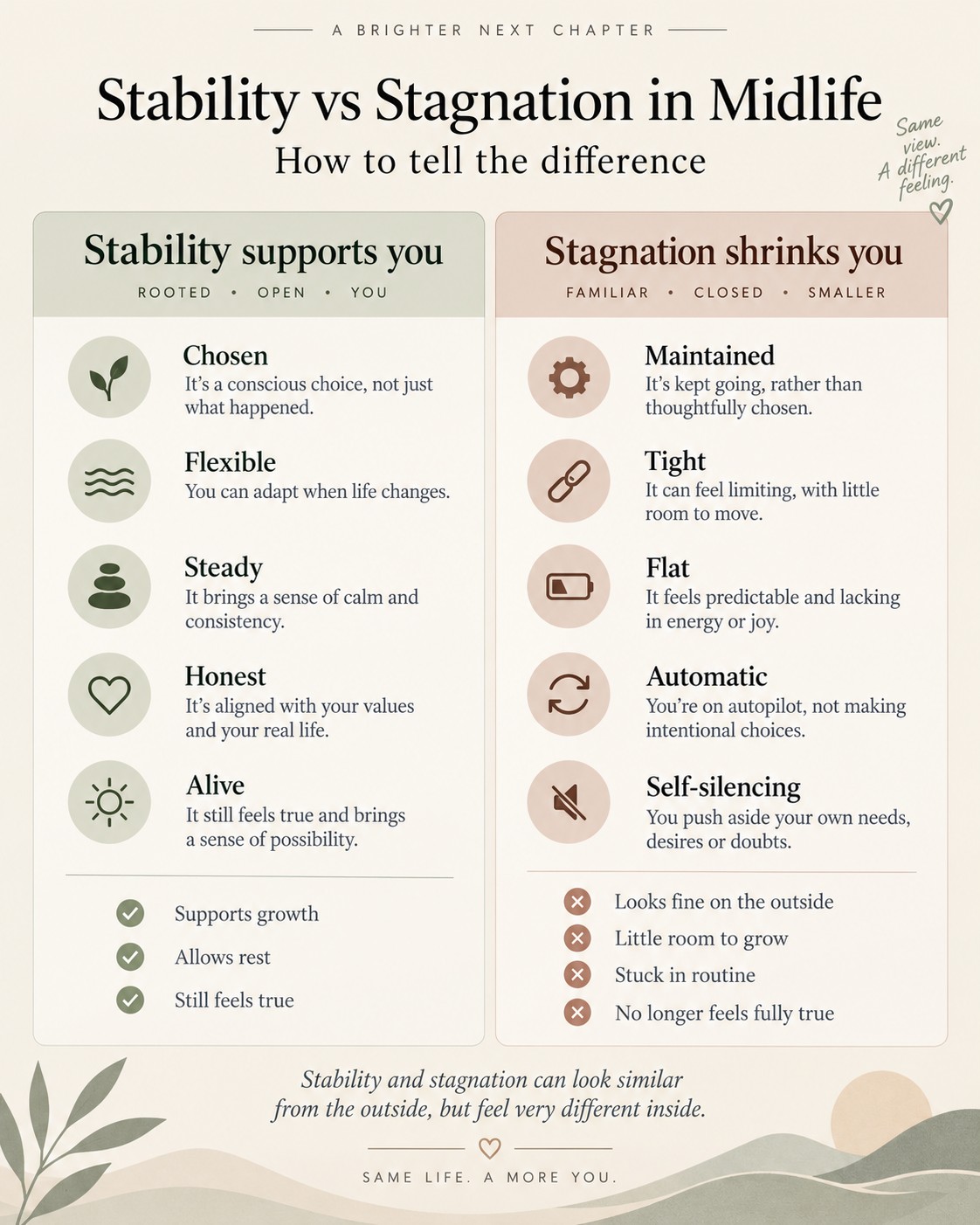 Stability and stagnation can look similar from the outside, but feel very different inside.
What Healthy Stability Still Allows
Healthy stability is not the same as keeping everything exactly the same.
At its best, stability gives you a steady base to live from.
It helps you feel grounded.
It gives your nervous system room to settle.
This is why stability vs stagnation in midlife needs to be judged by lived feel, not outward appearance.
It supports your responsibilities without making your whole life feel like a set of obligations.
It gives you enough structure to function, but enough space to still be yourself.
That is the key difference.
Healthy stability still allows movement.
You can make adjustments.
You can tell the truth.
You can rest without feeling guilty.
You can change your mind when something no longer fits.
You can grow without feeling as though you are betraying the life you have built.
In midlife, this matters because stability can be easy to misread.
A stable life may look ordinary from the outside.
Same home.
Same work.
Same routines.
Same responsibilities.
But if it still supports you, there will usually be some sense of choice inside it.
You may not love every part of your life.
You may still have pressures, limitations, and practical responsibilities.
But underneath those things, there is room to breathe.
Room to be honest.
Room to make small adjustments.
Room to keep becoming more of yourself.
That is healthy stability.
It does not trap you in place.
It gives you enough ground beneath your feet to take your next step deliberately.
What Stagnation Quietly Takes Away
Stagnation is not always dramatic.
It does not always look like crisis, collapse, or obvious unhappiness.
Sometimes stagnation looks very responsible.
You keep going.
You keep doing what needs to be done.
You maintain the routines.
You meet the expectations.
You hold things together.
From the outside, your life may still look stable.
That is what makes stability vs stagnation in midlife so hard to see clearly.
But inside, something may be narrowing.
Your choices may start to feel smaller.
Your energy may feel flatter.
Your days may feel more automatic.
You may stop asking what you want because it feels easier not to know.
You may avoid honest questions because you are afraid of what they might disturb.
That is one of the quiet ways stagnation works.
It does not always remove everything from your life.
It slowly reduces your sense of possibility.
You may still be functioning.
You may still be capable.
You may still be grateful for parts of your life.
But you may also feel as though you are living inside a version of yourself that no longer has enough room.
This is where many women in midlife get confused.
Because nothing may look wrong enough to justify the feeling.
There may be no obvious reason to complain.
No major disaster.
No clear breaking point.
Just a growing sense that the life you are maintaining is not giving much back to you.
That does not mean you have failed.
It may simply mean your stability has stopped supporting your growth and has started protecting your sameness.
How to Test Stability vs Stagnation in Midlife Without Overreacting
You do not need to decide immediately whether your whole life is right or wrong.
That is too much pressure.
A more useful question is:
“Is this season still supporting me, or am I only maintaining it because it is familiar?”
This is not about judging your life from the outside.
It is about noticing how your life feels from the inside.
Start gently.
Ask yourself whether your current stability still gives you room to be honest.
Can you name what you want?
Can you make small adjustments when something no longer fits?
Can you rest without feeling as though everything will fall apart?
Can you imagine a next step without feeling trapped by the life you already have?
This is one of the clearest tests of stability vs stagnation in midlife.
If the answer is mostly yes, your stability may still be serving you.
It may simply need a little more attention, honesty, or care.
If the answer is mostly no, something may have become too tight.
That does not mean you need to make a dramatic decision.
It means your life may be asking for a more honest conversation.
A good test is not:
“Does my life look fine?”
A better test is:
“Does my life still give me room to feel like myself?”
That question is quieter.
But it is usually more truthful.
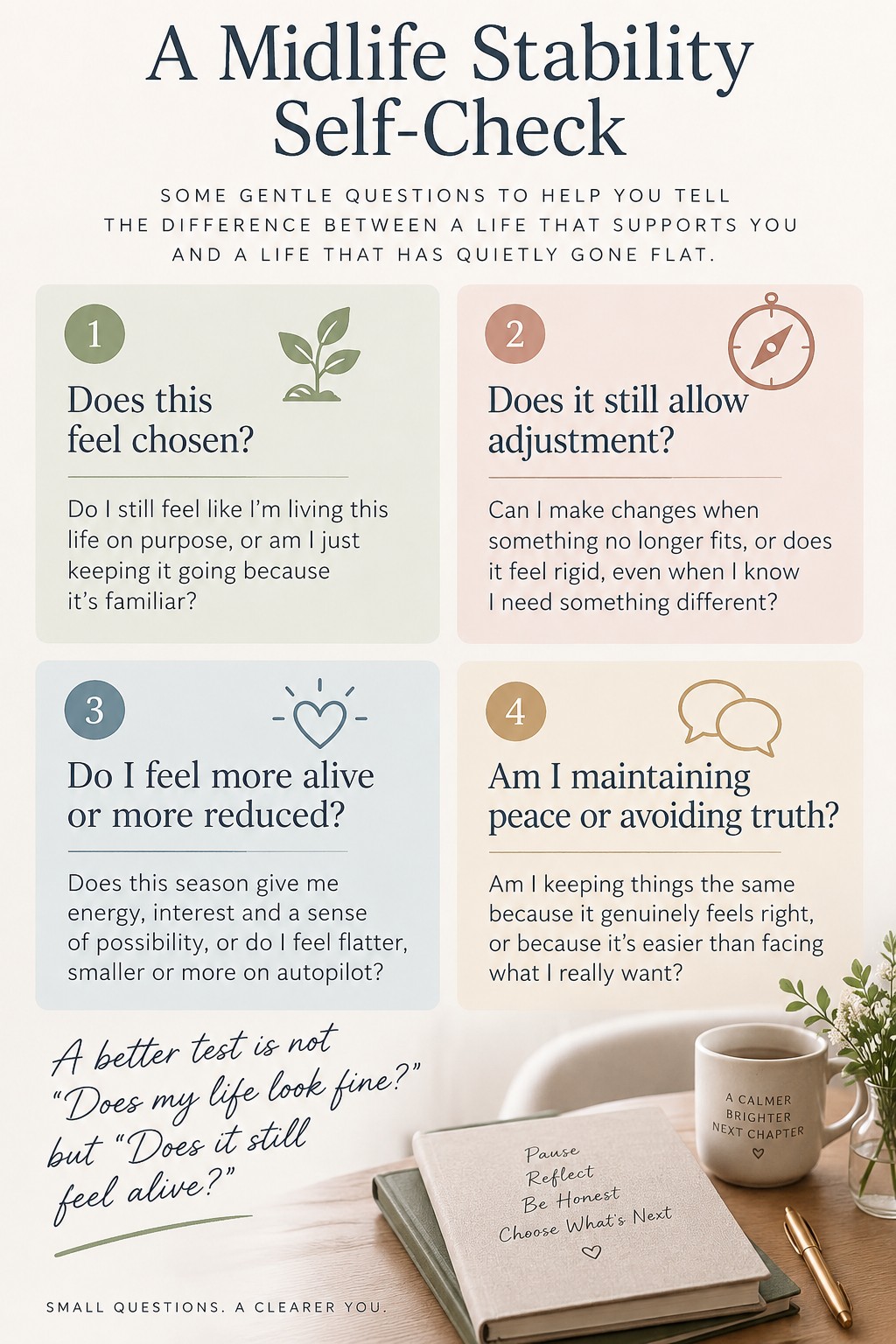 A better test is not “Does my life look fine?” but “Does it still feel alive?”
Signs Your Life Is Steady and Still Alive
A steady life can still be a very alive life.
The difference is not whether everything feels exciting.
It is whether your life still gives you enough space to be honest, present, and responsive to yourself.
Your life may be steady and still alive if:
You still feel some sense of choice in the way you are living.
You can make small changes without everything feeling threatened.
You have routines, but they do not completely own you.
You can rest, recover, and come back to yourself.
You can say what is true, even if you say it carefully.
You still feel connected to at least some of your values.
You may not have everything you want yet, but you do not feel completely cut off from possibility.
Healthy stability often feels simple rather than exciting.
It may feel like having a base.
A place to return to.
A rhythm that supports you.
A life that gives you enough steadiness to make thoughtful choices.
It does not mean you never feel bored, tired, uncertain, or frustrated.
It means those feelings can still be worked with.
There is still movement available.
There is still room to adjust.
There is still enough of you present in the life you are living.
Signs Your Life Is Functioning but No Longer Fitting
A life can function well and still no longer fit the woman living inside it.
This is one of the hardest parts to admit.
Because from the outside, the evidence may seem to say that everything is fine.
You may be managing your responsibilities.
You may be keeping the household, work, relationships, or family commitments moving.
You may be reliable.
You may be capable.
You may be doing what you have always done.
But inside, the fit may be changing.
You may feel more reduced than supported.
You may notice that your choices have become smaller.
You may feel as though you are maintaining peace by not saying what is true.
You may avoid certain questions because you already sense the answers would ask something of you.
You may feel tired before the day has even properly begun.
You may look at your life and think:
“This should be enough.”
But another part of you quietly knows:
“This does not feel like me anymore.”
That does not mean your life is bad.
It does not mean you are ungrateful.
It does not mean every part of your life needs to change.
It may simply mean the structure that once supported you has become too tight.
What once gave you security may now feel like limitation.
What once helped you cope may now keep you on autopilot.
What once felt like responsibility may now feel like self-abandonment.
That is the shift to pay attention to.
Not because it means you need to react immediately.
But because a life that no longer fits will usually keep asking to be noticed.
A Gentle Next Step If the Answer Is Uncomfortable

If you recognise that your life may be functioning but no longer fitting, try not to rush straight into a major decision.
That can create more pressure than clarity.
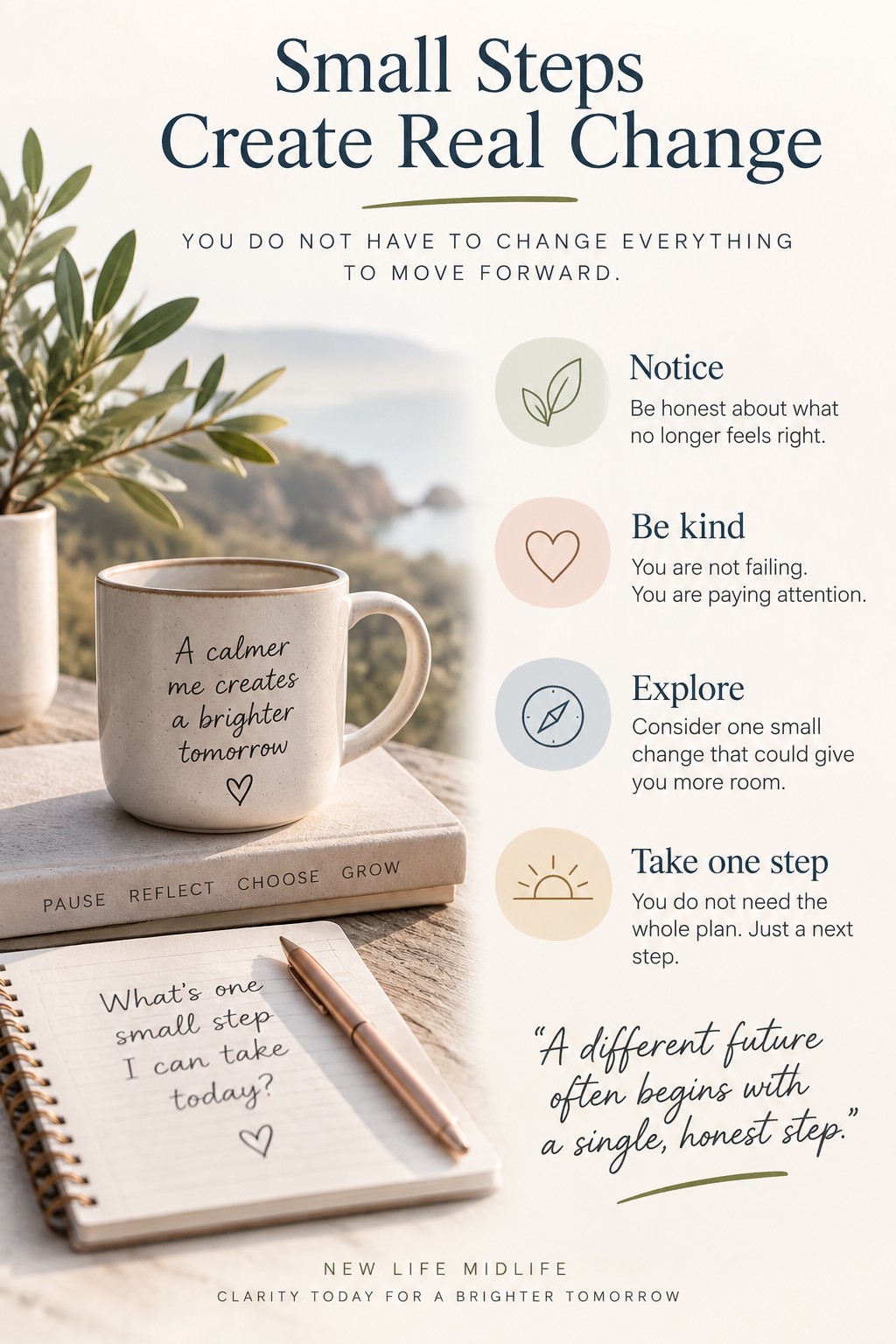
The first step is not to change everything.
The first step is to stop pretending there is nothing to notice.
You might begin with one small question:
“What is one part of my life that feels too tight now?”
Not wrong.
Not failed.
Not broken.
Just too tight.
Then ask:
“What would give me a little more room?”
That room might come from a conversation.
A boundary.
A change in routine.
A little more time alone.
A decision-light next step.
A pause before saying yes again.
A small act of honesty that does not require you to explain your whole life to anyone else.
This is how you begin to test whether stability can become supportive again.
You do not need to blow up your life to find out what is true.
You need enough honesty to notice what no longer fits.
Enough steadiness to avoid reacting from panic.
And enough self-trust to take one small step towards a life that gives you more room to be yourself.
The idea of stagnation in midlife also appears in Erik Erikson’s adult development theory, where generativity versus stagnation is described as one of the key psychological tasks of middle adulthood.
Ready to See Where Your Life Still Fits — and Where It May Need More Room?
If this page has helped you see the difference between stability vs stagnation in midlife, start gently.
You do not need to make a dramatic decision today.
The Wheel of Life Assessment can help you look across the main areas of your life and notice where things still feel supportive, and where something may have quietly become too tight.
If you would rather talk it through, a Clarity Call gives you space to explore what feels stable, what feels stuck, and what one honest next step could look like.
→ Complete the Wheel of Life Assessment
Privacy Policy