- Home
- Feeling Stuck
- Feeling Stuck But Life Looks Fine
- Life Guilt
Good-on-Paper Life Guilt: Why Do I Feel Guilty for Wanting Change?
Good-on-paper life guilt often happens when part of you wants change, but another part equates wanting more with ingratitude, selfishness, or upsetting other people. It does not automatically mean you need a dramatic overhaul, but it usually means something no longer fits. Below, name the guilt, understand what it may be protecting, and choose one honest next step.
 When life looks fine, guilt can still be pointing to something real.
Good-on-paper life guilt is the guilt that can appear when your life looks fine from the outside, but something inside no longer feels fully right.
Nothing may look obviously wrong.
You may have things you worked hard for.
You may have people you care about.
You may have responsibilities, routines, and parts of your life that genuinely matter to you.
And still, part of you may want something to change.
That is where the guilt often begins.
You may think:
“I should be grateful.”
“Other people have it worse.”
“What right do I have to want more?”
“Maybe I am being selfish.”
But guilt is not always proof that you are doing something wrong.
Sometimes guilt appears because you are starting to tell yourself the truth after a long time of keeping things steady.
It may be pointing to a mismatch between the life you are living and the woman you are becoming.
It may be showing you that something which once felt right now feels too small, too heavy, too flat, or no longer fully true.
That does not mean your whole life is wrong.
It means the guilt deserves to be understood before it is allowed to silence you.
What Good-on-Paper Life Guilt Is Really Pointing To
A life can look fine from the outside and still stop fitting on the inside.
That does not mean the life was wrong.
It may simply mean it was built around a version of you that has changed.
In midlife, this can become harder to ignore.
The roles you have carried may not feel the same.
The routines that once gave you structure may start to feel flat.
The responsibilities you have managed for years may begin to feel heavier than they used to.
The things you were supposed to want may no longer feel as meaningful.
From the outside, other people may still see the same life.
The same home.
The same work.
The same family role.
The same capable woman.
But inside, you may be noticing something different.
You may be asking quieter questions.
Is this still enough?
Is this still true?
Do I still want to live this way?
That is where good-on-paper life guilt can become stronger.
Because if nothing looks wrong, it can feel harder to admit that something no longer feels right.
But a life can be stable and still need to be re-examined.
It can be good in many ways and still need more honesty.
It can be full of things you value and still contain parts you have quietly outgrown.
What Your Guilt May Be Protecting
Guilt is not always there to punish you.
Sometimes it is trying to protect something.
It may be protecting the life you have worked hard to build.
It may be protecting the people who rely on you.
It may be protecting the identity you have carried for years.
It may be protecting the comfort of others.
It may be protecting the version of you who learned to be responsible, steady, useful, grateful, or easy to be around.
That is why good-on-paper life guilt can feel so strong.
It is not only about wanting change.
It is also about what change might disturb.
You may worry that if you admit something no longer fits, other people will be disappointed, confused, hurt, or inconvenienced.
You may worry that wanting more means rejecting everything you already have.
You may worry that if you start listening to yourself, you will not be able to keep everything else steady.
But guilt is not always the voice of truth.
Sometimes it is the voice of old loyalty.
Old responsibility.
Old expectations.
Old survival patterns.
It may be worth asking:
“What is this guilt trying to protect?”
And then:
“Is it still protecting something true, or is it keeping me from being honest?”
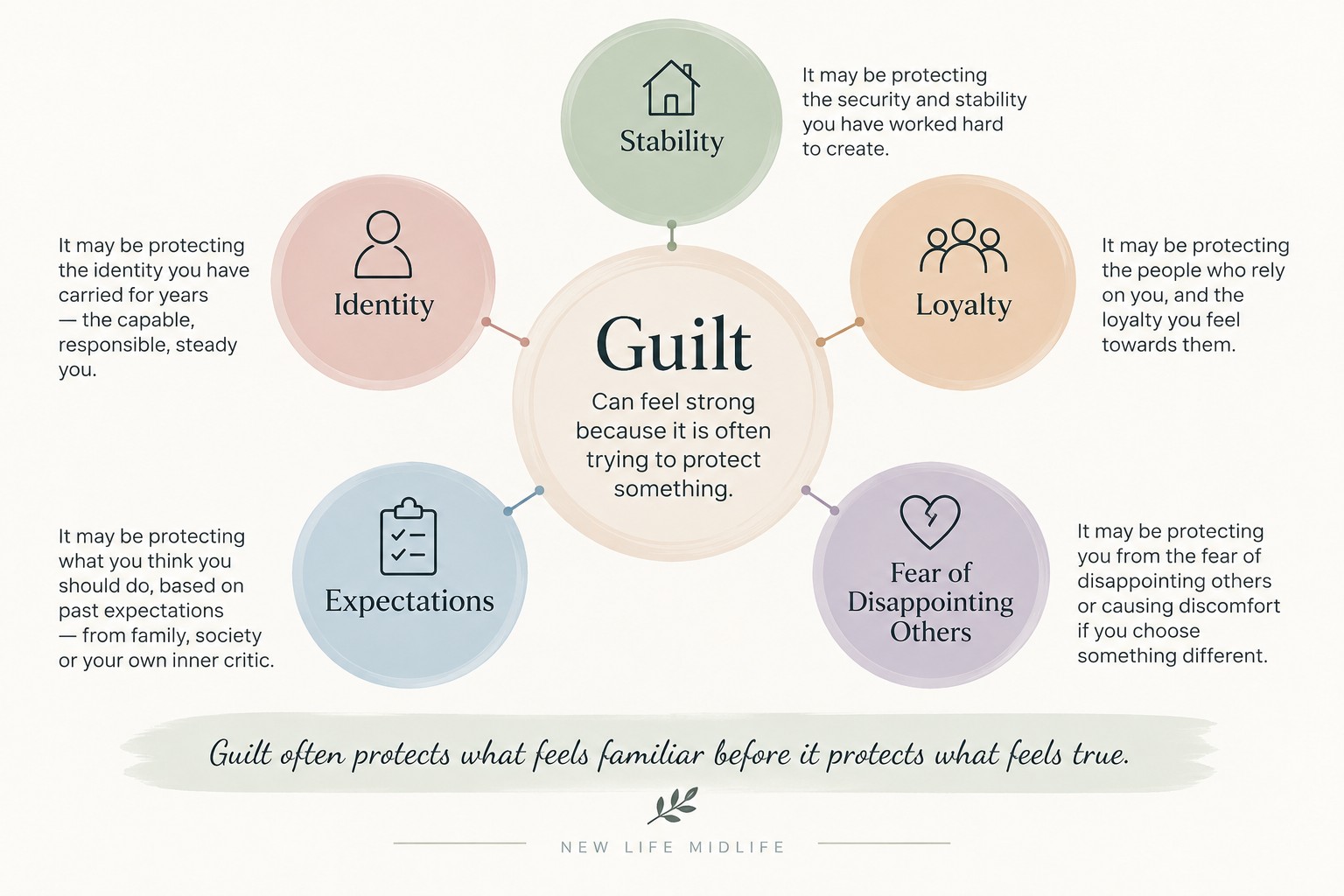 Guilt often protects what feels familiar before it protects what feels true.
Why Shame Makes This Harder to See Clearly
Good-on-paper life guilt becomes heavier when it turns into shame.
Guilt says, “I feel bad for wanting this.”
Shame says, “There is something wrong with me for wanting this.”
That difference matters.
Guilt can sometimes point to something worth noticing.
Shame usually makes you smaller.
It can make you question your character instead of listening to your truth.
You may start judging yourself before you have even understood what you are feeling.
You may tell yourself you are selfish, ungrateful, difficult, disloyal, or impossible to satisfy.
That kind of self-judgment does not create clarity.
It creates more pressure.
And when there is more pressure, it becomes harder to hear what is actually true.
You may push the feeling down.
You may stay busy.
You may convince yourself that wanting change is the problem.
But wanting change is not automatically the problem.
The real question is what that desire is trying to show you.
You can be honest with yourself without attacking yourself.
You can notice the guilt without letting it decide for you.
You can ask what no longer fits without turning that question into a verdict against your whole life.
What to Do Before You Make Any Big Decisions
 You do not need a full plan to take one honest step.
Before you make a big decision, slow the process down.
Good-on-paper life guilt can make you swing between two extremes.
One part of you may want to dismiss the feeling completely.
Another part may want to force a change just to get relief.
Neither extreme usually creates clarity.
A better first step is to name what is actually happening.
Ask yourself:
“What do I feel guilty for wanting?”
“What am I afraid this change would disturb?”
“What part of my life still matters to me?”
“What part no longer feels fully true?”
You are not trying to decide everything today.
You are trying to separate guilt from truth.
Once you have named the tension, choose one small, honest step.
That might be writing down what feels off, having one careful conversation, taking the Wheel of Life Assessment, booking quiet time to think, or choosing one decision-light next step.
The point is not to blow up your life.
The point is to stop letting guilt make every decision for you.
Good-on-paper life guilt begins to loosen when you can say:
“I can be grateful for what I have and still be honest about what no longer fits.”
If your guilt sits alongside persistent hopelessness, feeling unable to cope, or thoughts of harming yourself, please contact a qualified health professional or a crisis support service such as Lifeline Australia.
Ready to Understand What This Guilt Is Showing You?
If good-on-paper life guilt feels familiar, you do not need to force a major decision before you are ready.
Start by noticing what the guilt may be protecting, what no longer feels fully true, and what one honest step could look like.
The Wheel of Life Assessment can help you look across the main areas of your life and see where something may need more attention.
If you would rather talk it through, a Clarity Call gives you space to explore what feels unclear, what may no longer fit, and what your next honest step could be.
→ Complete the Wheel of Life Assessment
Privacy Policy