- Home
- Feeling Stuck
- Feeling Stuck But Life Looks Fine
- Invisible Grief
What Is the Invisible Grief of Midlife?
What is the invisible grief of midlife? It is the quiet sorrow that comes from losses that are real but hard to point to, such as outgrown roles, changing relationships, unlived possibilities, lost time, or futures that no longer fit. It may not look dramatic, but it still needs acknowledgment.
 Some losses do not look dramatic, but they still change you.
What Is the Invisible Grief of Midlife Really About?
The invisible grief of midlife is often hard to name because nothing may have obviously ended.
There may be no funeral.
No final conversation.
No single date you can point to and say, “That is when I lost this.”
Your life may still look much the same from the outside.
You may still be working, caring, managing, showing up, and doing what needs to be done.
But inside, something may feel tender.
Heavy.
Flat.
Quietly sad.
As though you are carrying a loss that other people cannot see.
This kind of grief can appear when you realise that a role no longer fits you.
Or that a version of yourself has gone quiet.
Or that a future you once imagined may not happen in the way you hoped.
It can also appear when you start to see how much time has passed, how much you have carried, or how much of yourself was shaped around other people’s needs.
That does not make you ungrateful.
It does not mean your life is bad.
It does not mean you are being dramatic.
It means something in you is noticing loss.
And when loss has not been named, it often shows up as stuckness, heaviness, irritability, guilt, numbness, or a quiet sense that life should feel more alive than it does.
Invisible grief of midlife is not always asking you to change everything.
Sometimes it is asking you to let something count.
That is why understanding what is the invisible grief of midlife can help you stop dismissing what you feel.
What This Quiet Grief Is Often Made Of
The invisible grief of midlife is rarely made of one simple thing.
That is why asking what is the invisible grief of midlife can open up more than one answer.
It is often layered.
You may be grieving parts of life that changed slowly.
You may be grieving roles that once gave you identity, but now feel too narrow.
You may be grieving relationships that still exist, but no longer feel the same.
You may be grieving time.
Choices.
Possibilities.
The version of yourself who thought life would look or feel different by now.
This can be confusing because many of these losses are not obvious from the outside.
No one may see them.
No one may know there is anything to acknowledge.
You may not even have given yourself permission to call them losses.
Instead, you may tell yourself you are tired.
Restless.
Ungrateful.
Difficult.
Overthinking.
But sometimes the heaviness has a reason.
Something mattered.
Something changed.
Something did not happen.
Something ended quietly.
Something in you moved on before your outer life caught up.
When you start naming what this grief is made of, the feeling can become less vague.
It may still be tender.
But it becomes more understandable.
This is the value of asking what is the invisible grief of midlife before trying to fix the feeling.
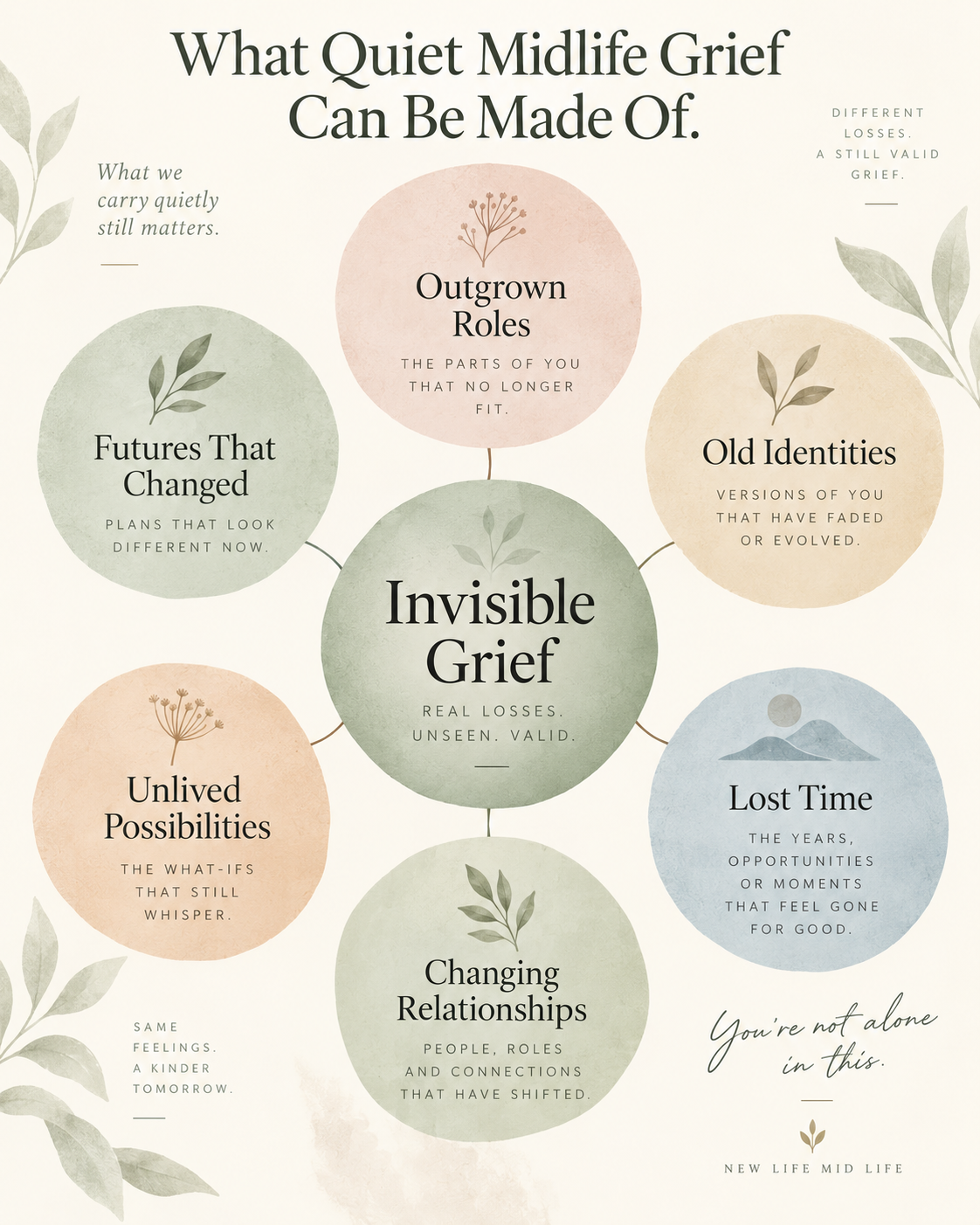 Invisible grief often comes from several small or ambiguous losses at once.
Outgrown Roles and Old Identities
One part of the invisible grief of midlife can come from outgrown roles.
These are the roles that once gave your life shape.
Mother.
Partner.
Daughter.
Carer.
Reliable one.
Strong one.
Capable one.
Peacemaker.
Achiever.
The one who holds everything together.
Some of these roles may still matter to you.
Some may still be part of your life.
But they may no longer feel like enough to explain who you are.
That can feel unsettling.
Because when a role has organised your life for years, outgrowing part of it can feel like losing a version of yourself.
You may miss who you used to be.
You may miss the certainty of knowing what was expected of you.
You may feel guilty for wanting more space beyond the role.
You may feel confused because nothing has obviously gone wrong.
But identity can change quietly.
The woman you were ten or twenty years ago may have needed those roles.
They may have helped you belong, cope, provide, love, protect, or survive.
But midlife can bring a different question.
Not only:
“Who needs me?”
But also:
“Who am I now?”
That question can carry grief.
Not because the past was wrong.
But because something in you knows you cannot keep living only as the woman you used to be.
Lost Futures, Lost Time, and Changing Relationships
The invisible grief of midlife can also come from futures that did not happen.
Not because you failed.
Not because your life has been meaningless.
But because some possibilities naturally narrow with time.
There may be versions of life you once imagined that now feel less likely.
A relationship that did not become what you hoped.
A career path you did not take.
A family shape that changed.
A place you thought you might live.
A version of yourself you thought you would have become by now.
A dream you kept putting off until there was more time, more money, more confidence, or fewer responsibilities.
This kind of grief can be hard to admit because the loss may not be visible.
No one else may know what that imagined future meant to you.
No one else may realise you are grieving something that never fully existed in the outside world.
But imagined futures can still matter.
They can carry hope.
Identity.
Belonging.
Possibility.
A sense of who you thought you were becoming.
Midlife can also bring grief around time.
The years already spent.
The years spent coping.
The years spent being what other people needed.
The years spent waiting for life to feel easier, freer, or more your own.
 Some paths close quietly, even when life keeps moving.
And relationships can shift too.
People change.
Children grow.
Parents age.
Friendships alter.
Partners may feel closer, further away, or different from who they once were.
You may still love people and still grieve what has changed.
You may still value your life and still feel sadness for the paths that quietly closed.
This is not self-pity.
It is recognition.
Some things mattered.
Some things changed.
Some things did not happen.
This is another part of what is the invisible grief of midlife: mourning what mattered, even if it was never fully visible to anyone else.
And part of working with the invisible grief of midlife is allowing those losses to be real, without letting them become the whole story.
This is not self-pity.
It is recognition.
Some things mattered.
Some things changed.
Some things did not happen.
This is another part of what is the invisible grief of midlife: mourning what mattered, even if it was never fully visible to anyone else.
And part of working with the invisible grief of midlife is allowing those losses to be real, without letting them become the whole story.
How Invisible Grief Shows Up When Life Looks Fine
Invisible grief of midlife does not always show up as obvious sadness.
Sometimes it shows up as heaviness.
You may feel tired in a way that rest does not fully explain.
You may feel flat, even when nothing is especially wrong.
You may feel irritated by things that should not bother you that much.
You may feel tender around certain memories, conversations, milestones, or reminders.
You may feel guilty for wanting more when you already have things to be grateful for.
You may feel restless, but not know what you are restless for.
You may feel numb in places where you expected to feel more alive.
That is what makes this kind of grief confusing.
Your life may still be functioning.
People may still see you as capable.
You may still be showing up, doing the work, caring for others, and keeping things moving.
But inside, there may be a quiet sense of loss that has not been given language.
 Grief does not always arrive as tears; sometimes it arrives as heaviness or flatness.
You might find yourself thinking:
“Why do I feel sad when nothing has happened?”
“Why do I feel heavy when my life looks fine?”
“Why am I not more grateful?”
“Why does everything feel a little muted?”
These questions do not mean you are broken.
They may mean something in you is asking to be acknowledged.
The invisible grief of midlife can stay hidden for a long time because there is no obvious place to put it.
But once you start recognising it as grief, rather than failure, weakness, or ingratitude, it can become easier to meet it with honesty instead of judgment.
A Gentle Way to Work With It
You do not need to rush invisible grief into a solution.
Some losses need to be named before they can be worked with.
That does not mean you have to stay inside the grief.
It means you stop dismissing it as nothing.
A gentle starting point is to ask:
“What am I grieving that I have not allowed myself to call grief?”
This question is one practical way to explore what is the invisible grief of midlife in your own life.
You might be grieving a role.
A relationship.
A version of yourself.
A future that did not happen.
A sense of time passing.
A part of life that once felt possible, but now feels further away.
Let the answer be simple.
You do not need to explain it perfectly.
You do not need to prove that the loss is big enough.
You do not need anyone else to agree before you are allowed to acknowledge it.
Then ask:
“Why did this matter to me?”
That question helps you treat the grief with respect.
Maybe it mattered because it gave you hope.
Maybe it mattered because it helped you feel needed.
Maybe it mattered because it gave your life shape.
Maybe it mattered because it represented freedom, love, belonging, achievement, security, or possibility.
When you can see why it mattered, you can begin to honour it without being trapped by it.
That may be where the next small step begins.
Name It, Honor It, and Make One Small Allowance
A simple way to work with invisible grief is to give it three small places to land.
First, name what was lost.
You might write:
“I am grieving the version of my life I thought I would have by now.”
“I am grieving the role that used to give me purpose.”
“I am grieving the time I spent surviving instead of choosing.”
“I am grieving the relationship I hoped would feel different.”
“I am grieving the woman I did not get to become then.”
Second, honour why it mattered.
This part is important.
You are not trying to talk yourself out of the grief.
You are not trying to make the loss smaller.
You are simply allowing yourself to admit that it mattered.
You might say:
“That mattered because it gave me hope.”
“That mattered because it helped me feel loved.”
“That mattered because it gave my life direction.”
“That mattered because it represented freedom.”
“That mattered because I wanted that version of myself to have a chance.”
Third, make one small allowance.
This does not need to be dramatic.
It might be giving yourself ten quiet minutes to write honestly.
It might be taking a walk without trying to fix anything.
It might be putting away something symbolic that still holds sadness.
It might be letting yourself cry without explaining it away.
It might be choosing one small act that makes room for who you are becoming now.
The point is not to stay in the past.
The point is to stop pretending the past did not cost you anything.
When grief is acknowledged, it often becomes less tangled with shame.
It may still be tender.
But it can begin to move.
And sometimes that is enough for the next small piece of life to become possible.
Invisible grief is closely related to disenfranchised grief, which describes grief that is not openly acknowledged, publicly mourned, or socially supported.
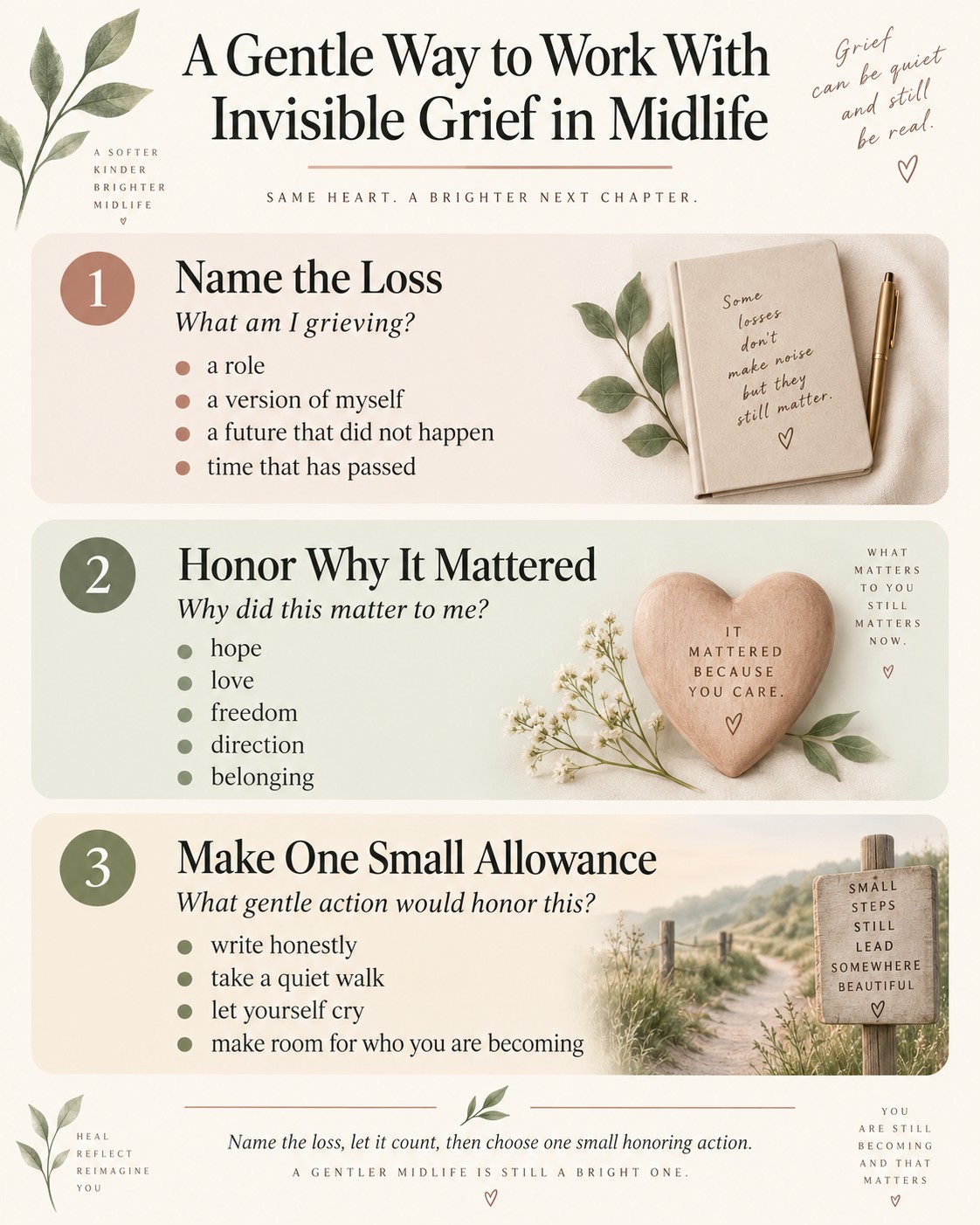 Name the loss, let it count, then choose one small honouring action.
Ready to Understand What This Grief May Be Showing You?
If the invisible grief of midlife feels familiar, you do not need to rush it into a solution.
Start by naming what feels lost, why it mattered, and what small allowance might help you meet it with honesty rather than judgment.
The Wheel of Life Assessment can help you look across the main areas of your life and notice where something may need more care, attention, or room.
If you would rather talk it through, a Clarity Call gives you space to explore what feels heavy, what may be changing, and what one gentle next step could look like.
→ Complete the Wheel of Life Assessment
Privacy Policy