- Home
- Feeling Stuck
- Feeling Stuck But Life Looks Fine
- Micro-Changes
Micro-Changes When Feeling Stuck: What Small Steps Help?
Micro-changes when feeling stuck are small, low-risk shifts that give you information and energy without forcing a dramatic decision. Think of them as experiments, not fixes: they help you build evidence, notice what feels more honest, and regain movement before you redesign your life.
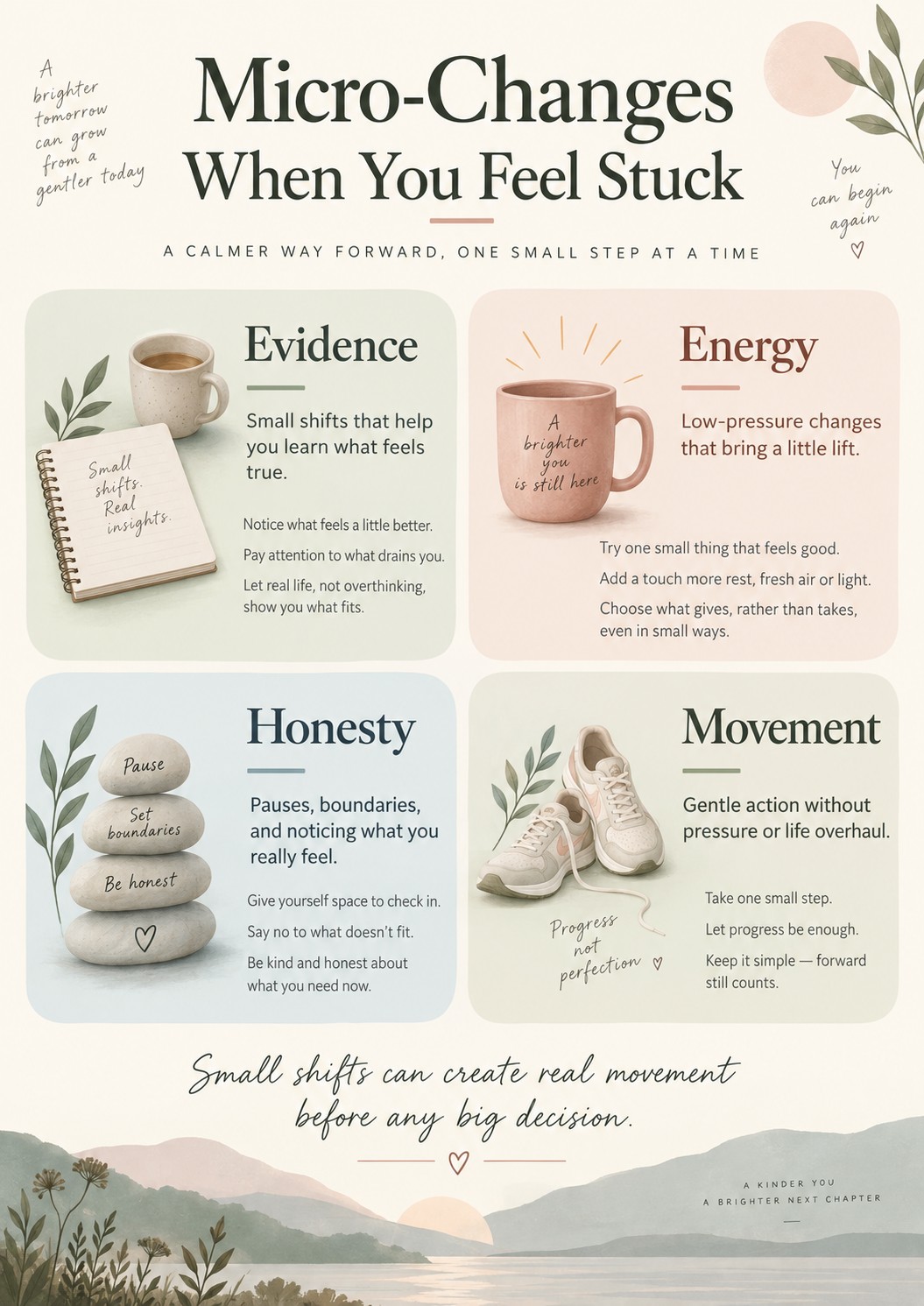
Micro-Changes When Feeling Stuck That Give You Evidence
When you feel stuck, it is tempting to look for the big answer.
What should I do with my life?
Should I change direction?
Is this still right for me?
Do I need to make a major decision?
Those questions may matter eventually, but they can be too heavy at the beginning.
A micro-change gives you a smaller place to start.
A useful micro-change is not a full life plan.
It is not a promise to change everything.
It is not another self-improvement project to keep up with.
It is a small, low-risk shift that helps you gather evidence.
You are testing something gently.
What gives me a little more energy?
What helps me feel more honest?
What makes the day feel slightly less automatic?
What shows me what I want now?
That is why micro-changes when feeling stuck can be so useful.
They help you stop trying to think your way into clarity and start noticing what real life shows you.
A good micro-change should be:
small enough to try today
reversible if it does not help
honest enough to reveal something
kind enough not to become another pressure
You are not trying to fix yourself.
You are trying to learn from yourself.
That is a very different starting point.
Your second block of text...
Micro-Changes That Restore a Little Energy
When you feel stuck, your energy can become one of the first things to flatten.
You may not feel completely exhausted.
You may still be functioning.
You may still be doing what needs to be done.
But there may be very little lift in your day.
That is why a useful micro-change does not have to be impressive.
It only needs to create a small shift in state.
A little more light.
A little more movement.
A little more space.
A slightly different rhythm.
A small break from the same pattern.
You are not trying to redesign your whole routine.
You are testing what gives you even a small amount of energy back.
That might mean stepping outside for five minutes before you start the next task.
It might mean changing rooms instead of pushing through in the same chair.
It might mean putting music on while you do something ordinary.
It might mean making one part of your morning softer, slower, or less rushed.
It might mean doing one small thing before your phone, inbox, or responsibilities claim the day.
These are not magic answers.
They are small experiments.
The point is to notice what happens.
Do you feel slightly clearer?
A little more present?
Less trapped in the same loop?
More able to hear yourself?
Micro-changes when feeling stuck work best when they are small enough that you do not have to argue with yourself for half the day before trying them.
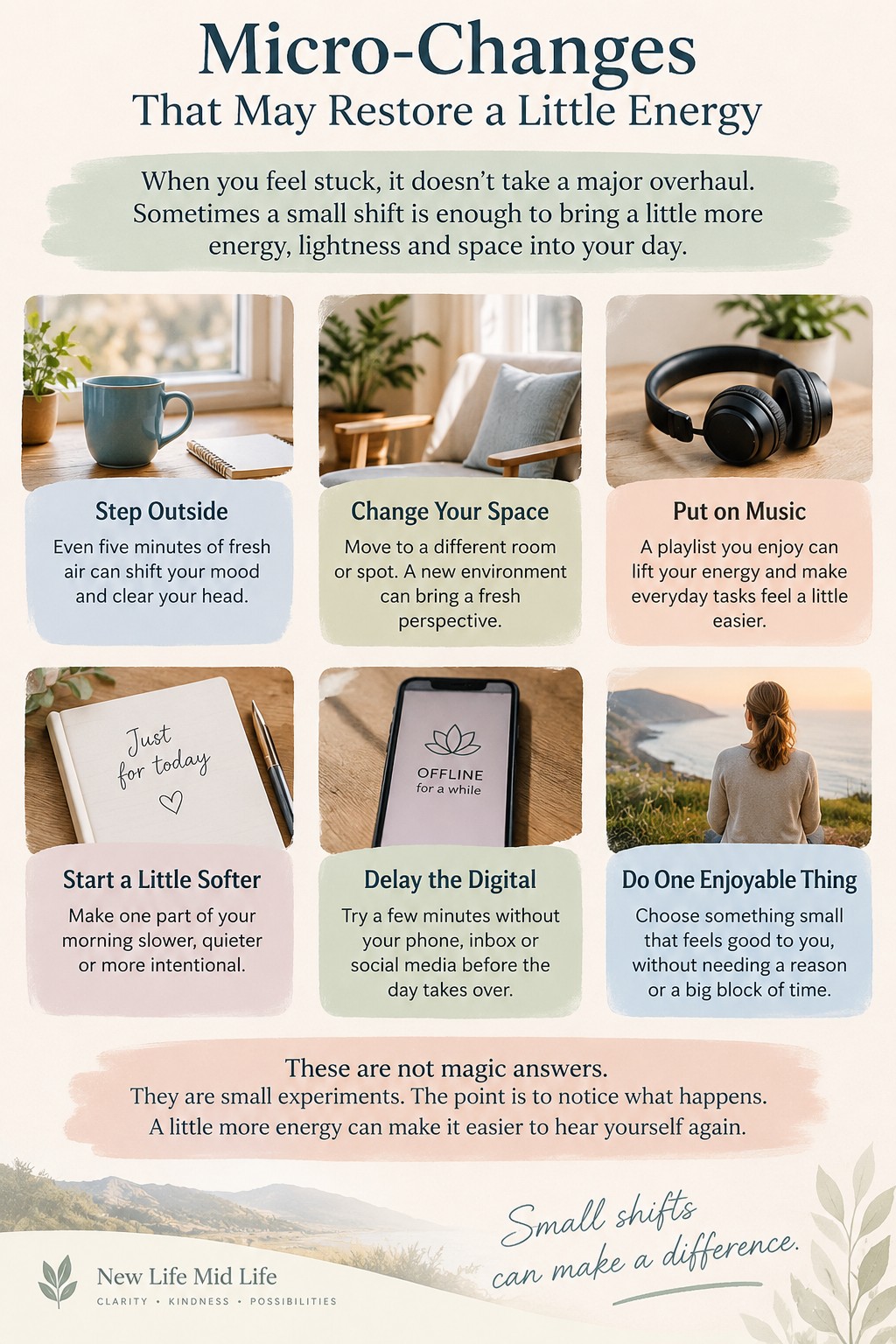 Energy shifts work best when they stay small enough to try today.
Change One Input Before You Change Your Whole Routine
When life feels flat, it is easy to assume you need a completely new routine.
A better starting point may be to change one input.
One input means one small thing that affects your state.
Light.
Sound.
Movement.
Environment.
Pace.
Food.
Rest.
Connection.
You are not trying to become a different person overnight.
You are simply interrupting the sameness long enough to see whether something shifts.
For example, instead of deciding you need a whole new morning routine, you might open the blinds earlier.
Instead of forcing yourself into a major fitness plan, you might walk around the block once.
Instead of working through the same tired pattern, you might move to a different room.
Instead of scrolling while feeling flat, you might put on one song that changes the energy slightly.
These things may look too small to matter.
But when you feel stuck, small changes can show you where your energy responds.
That information matters.
It helps you notice the difference between what drains you, what supports you, and what gives you a little more room.
Micro-changes when feeling stuck are not about proving discipline.
They are about gathering clues.
Micro-Changes That Make Your Truth Easier to Hear
Some micro-changes are not about energy.
They are about honesty.
When you feel stuck, your own truth can become hard to hear.
Not because you do not know anything.
But because your days may be full of noise, expectation, habit, and automatic responses.
You may keep saying yes before you have checked whether you mean it.
You may keep doing what is expected because it is easier than explaining what has changed.
You may keep pushing down small feelings because they seem inconvenient, unreasonable, or hard to justify.
Over time, this can make you feel disconnected from yourself.
A truth-based micro-change gives you a small pause.
It helps you notice what is real before you override it.
That might mean taking five minutes before answering a request.
Writing down what you actually felt after a conversation.
Noticing where your body tightens during the day.
Letting yourself admit, privately, “I do not want this,” without needing to act on it immediately.
Or asking, “What would I choose if I did not have to explain this to anyone yet?”
These are small acts.
But they matter.
They give your inner voice a little more room.
Micro-changes when feeling stuck are useful because they do not force you to make a public declaration before you are ready.
They simply help you hear yourself more clearly.
Replace Automatic Yes With a Pause
One of the simplest micro-changes when feeling stuck is to stop answering everything immediately.
Especially if your automatic answer is usually yes.
Yes, I can do that.
Yes, that is fine.
Yes, I will sort it.
Yes, I can manage.
Yes, I do not mind.
Sometimes those yeses are genuine.
But sometimes they are habits.
They may come from guilt.
They may come from wanting to keep the peace.
They may come from not wanting to disappoint people.
They may come from years of being the capable one.
A pause gives you a little space between the request and your response.
It does not mean you have to say no.
It simply gives you time to check whether your yes is honest.
You might say:
“Let me think about that.”
“I need to check what I have capacity for.”
“I will come back to you.”
“I am not sure yet.”
“I need a little time before I answer.”
That pause may feel uncomfortable at first.
But it can show you a lot.
You may notice relief.
You may notice fear.
You may notice resentment.
You may notice that you were about to agree to something you did not really want.
That is useful information.
A pause is small.
But it can interrupt a lifetime of overriding yourself.
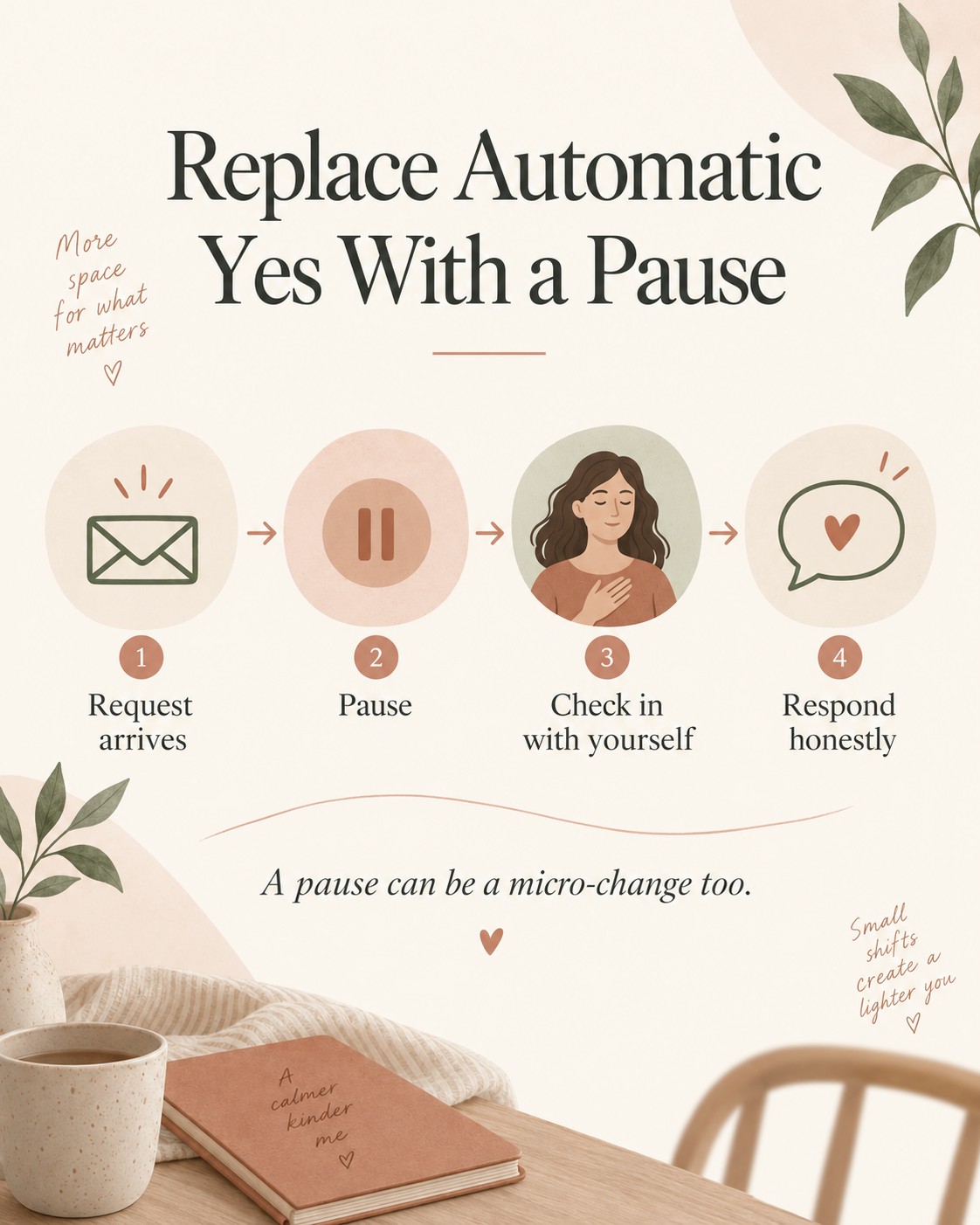 A pause can be a micro-change too.
Micro-Changes That Create Movement Without Pressure
Movement does not have to mean momentum.
It does not have to mean making a decision, setting a goal, announcing a change, or committing to a new direction.
When you feel stuck, movement can be much smaller than that.
It can be one different choice.
One conversation.
One visit somewhere new.
One small experiment.
One thing you try without needing to know where it will lead.
This matters because pressure can make stuckness worse.
If every small action has to become proof of a bigger plan, you may avoid taking action at all.
A pressure-free micro-change lets you move without making the movement mean too much.
You might try a class once.
You might visit a place you have been thinking about.
You might rearrange one part of your home.
You might spend an hour looking into something that keeps calling your attention.
You might have one honest conversation without needing to solve the whole issue.
You might choose one thing differently this week simply to see how it feels.
The point is not to force certainty.
The point is to create contact with real life again.
Micro-changes when feeling stuck help you gather information through action.
You begin to notice what gives you energy.
What feels heavy.
What feels surprisingly right.
What you keep resisting.
What you want more of.
What you are ready to stop pretending about.
That is movement.
Not because everything changes at once.
But because you are no longer waiting for complete clarity before you begin.
How to Tell Whether a Micro-Change Is Helping
A micro-change does not have to transform your whole life to be useful.
It only has to show you something.
That is why the question is not:
“Did this fix everything?”
The better question is:
“What did this help me notice?”
A micro-change may be helping if you feel a little more energy.
Or a little less dread.
Or slightly more room to breathe.
It may be helping if you hear yourself more clearly.
If you notice what drains you.
If you feel more honest about what you want.
If one next step becomes easier to see.
Sometimes the useful result is not comfort.
Sometimes the useful result is information.
You might realise that a routine is not working.
You might notice that a certain conversation always leaves you smaller.
You might discover that one small shift gives you more lift than you expected.
You might see that what you thought was laziness was actually a lack of fit.
That is progress.
Not because you have solved everything.
But because you are no longer guessing from inside the same pattern.
Micro-changes when feeling stuck are not about forcing certainty.
They are about creating enough movement to see what is true.
So choose one.
Try it gently.
Notice what changes.
Then let that information guide the next small step.
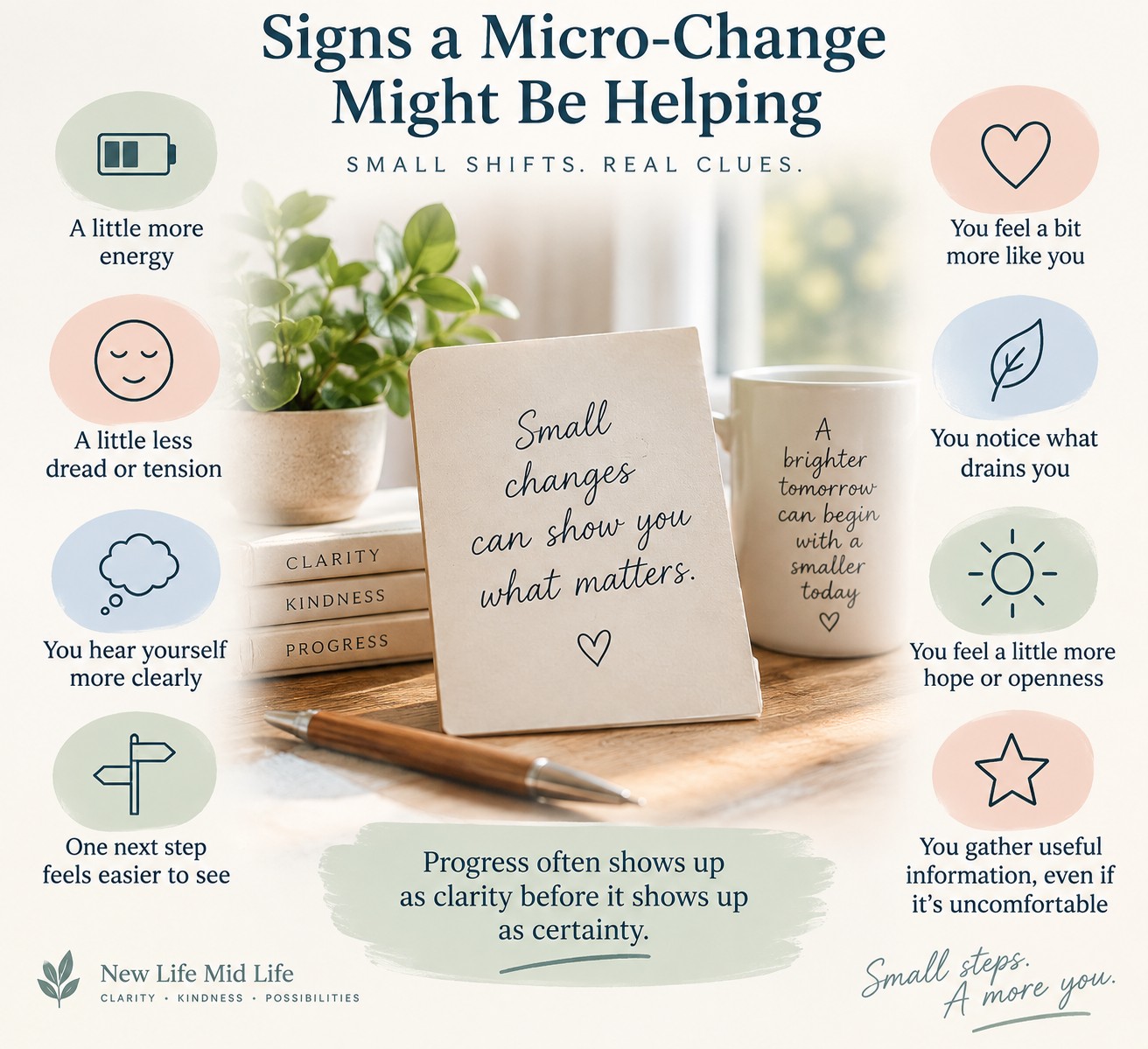 Progress often shows up as clarity before it shows up as certainty.
Small changes can also be understood through the idea of habit formation, where tiny repeated actions can make change feel less overwhelming and more manageable.
Ready to Take One Small Step Without Overhauling Your Life?
If micro-changes when feeling stuck feels like the right place to begin, keep it simple.
You do not need ten changes.
You do not need a full plan.
You only need one small shift that helps you notice what gives you more energy, honesty, evidence, or movement.
The Wheel of Life Assessment can help you look across the main areas of your life and see where one small change may be most useful.
If you would rather talk it through, a Clarity Call gives you space to explore what feels stuck, what may be asking for attention, and what one gentle next step could look like.
→ Complete the Wheel of Life Assessment
Privacy Policy